

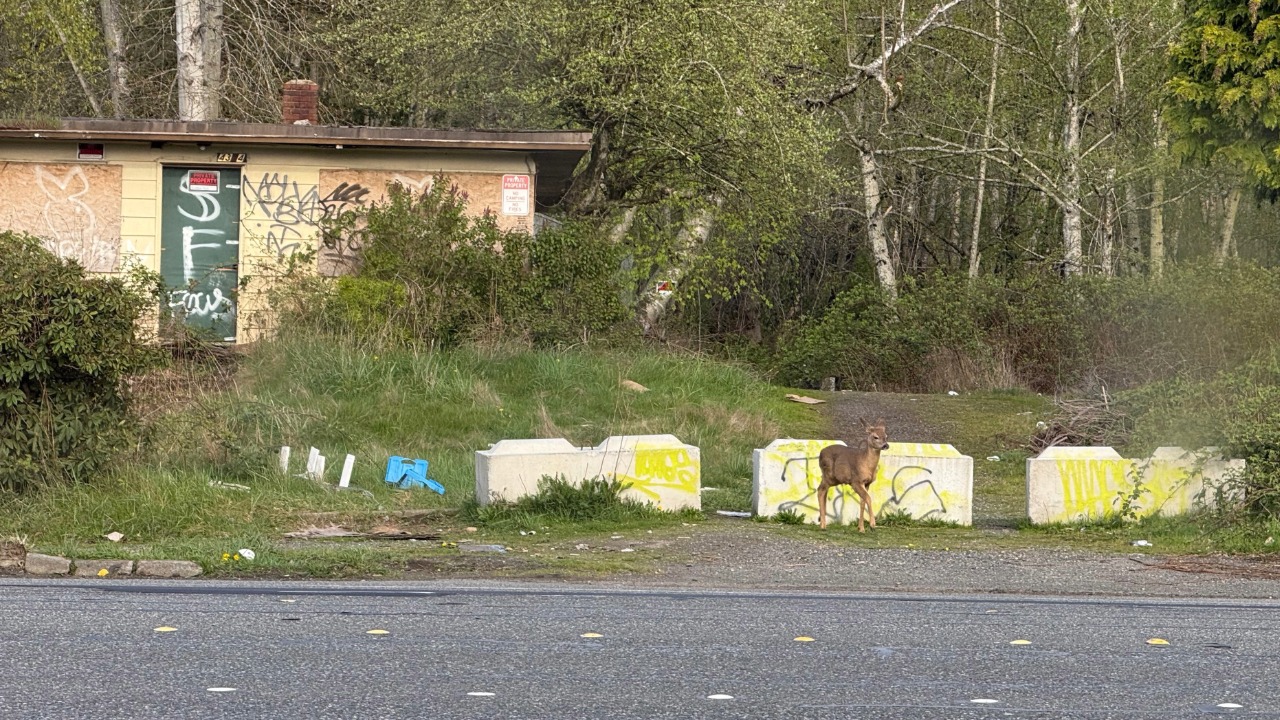
A deer emerges from out of the woods on the 4300 block of Meridian Street. A couple of days later smoke from the abandoned structure near the wooded area frequented by residents of the King Mountain encampment would shut down Guide Meridian for hours. (Photo: PNW Daily)
BELLINGHAM, Wash. — Early Monday morning, fire crews raced to the 4300 block of Meridian Street after smoke appeared from an abandoned structure near the wooded area frequented by residents of the King Mountain encampment. The blaze closed all lanes of Guide Meridian for hours.
It was, for many north Bellingham residents, another entry in a long and familiar ledger.
For years, residents in neighborhoods surrounding the King Mountain area have documented fires, gunshots, and crime they associate with the large illegal encampment that has expanded across multiple parcels of public and private land near East Bakerview Road.
Some call it the “King Mountain Autonomous Zone,” which is a term that reflects their sense that the area operates outside standard enforcement reach. Much like similar autonomous zones that popped up during the pandemic and 2020 civil unrest. The city has taken legal action against property owners to force cleanups, but progress has been slow and residents remain frustrated.
The fire investigation remains ongoing. Officials have not confirmed a cause.
Bellingham Blames Seattle. The Data Tells a Different Story.
It is a common refrain in Whatcom County: Seattle’s problems are flowing north.
And in some documented cases, that is true as law enforcement has identified organized drug trafficking networks moving fentanyl and other substances from Seattle and King County into Whatcom County distribution points. However, when you look at the actual data driving daily disorder in Bellingham, the picture is largely local.
In 2025, 22 individuals accounted for 253 arrests in Bellingham, which is 5.7% of all arrests made by BPD that year, according to a similar analysis published by Bellingham Scan of Bellingham Police Department arrest data. These are not outside actors. They are people already in the system, cycling through a structure that struggles to hold them.
Whatcom County’s unsheltered homeless population grew from 243 in 2024 to 337 in 2025, even as total counted homeless held steady at 815. Fewer shelter beds and persistent barriers to housing mean more people in the woods, in abandoned structures, and along commercial corridors. This means more calls for service as a result.
The Bellingham Police Department is actively making drug arrests and as weather warmed up in March, sent out the bike patrols.
“Patrol officers also made 22 arrests for drug violations, with 13 of those made by the BPD Bike Patrol Team,” a BPD post in March said.
Bellingham Police — Calls for Service 2026 (Jan–Apr)
Where Seattle Does Show Up
The Seattle connection is documented in one key area: drug trafficking networks. Law enforcement reports organized groups using a dispatcher-style model, sending runners from regional hubs into Whatcom County to distribute fentanyl and other drugs.
In July 2025, the Whatcom Regional Drug Task Force and DEA Bellingham Resident Office arrested Andres Venegas Hernandez, 57, of Oak Harbor. He was charged with leading organized crime and five counts of fentanyl delivery. Investigators seized about 435 grams of suspected heroin, 1,212 grams of cocaine, and roughly 5,000 fentanyl-laced blue M30 pills from his residence. Authorities believe Hernandez coordinated distribution into Whatcom County and laundered proceeds.
In March 2026, WRDTF and DEA investigators executed search warrants at multiple Seattle locations. They arrested Arnulfo Chapa-Urgiles, 33, and Dario Misacango Gutama, 49, both of Seattle. Authorities seized about 741 grams of fentanyl, 222 grams of methamphetamine, 124 grams of cocaine, and 13 grams of heroin. Investigators also recovered more than $7,000 in suspected drug proceeds.
“These defendants were trafficking fentanyl, cocaine, methamphetamine, and heroin on the streets of western Washington,” U.S. Attorney Charles Neil Floyd said of a related October 2025 case. “These drugs take a heavy toll on our community.”
In a separate October 2025 operation, DEA and Seattle Police arrested ten people tied to three linked drug and gun trafficking conspiracies. Search warrants at 12 locations uncovered 25 kilograms of fentanyl powder, more than 90,000 fentanyl pills, and 24 firearms at a single stash site.
The Gap Between Law and Reality
Washington law creates real constraints on how cities respond to high-frequency, low-level offenders. Many of the most commonly reported incidents such as trespass, theft, and drug possession are misdemeanors. They carry short jail stays or diversion rather than incarceration.
The result is a revolving door that residents experience as a system that cannot or will not hold repeat offenders accountable.
The 22-person, 253-arrest concentration is a symptom of that structure. Those individuals are not anonymous outsiders. They are locals in crisis the system has already touched repeatedly and released. The question of whether Washington law gives cities adequate tools to intervene in those cycles is one local officials have not fully answered.
Meanwhile, a Bellingham Housing Authority plan to build 110 units of affordable housing near the King Mountain area has a projected construction start of around 2030. The fire on Meridian Street happened Monday morning.
The gap between those two timelines is where Bellingham currently lives.
The 22-person, 253-arrest concentration is a symptom of that structure. Those individuals are not anonymous outsiders. They are locals in crisis the system has already touched repeatedly and released.
Frequently Asked Questions
Editor’s note, this article was updated to correct math errors and and links.
About the Author


3 thoughts on “Bellingham Blames Seattle: Data Says the Crisis Is Complicated”