

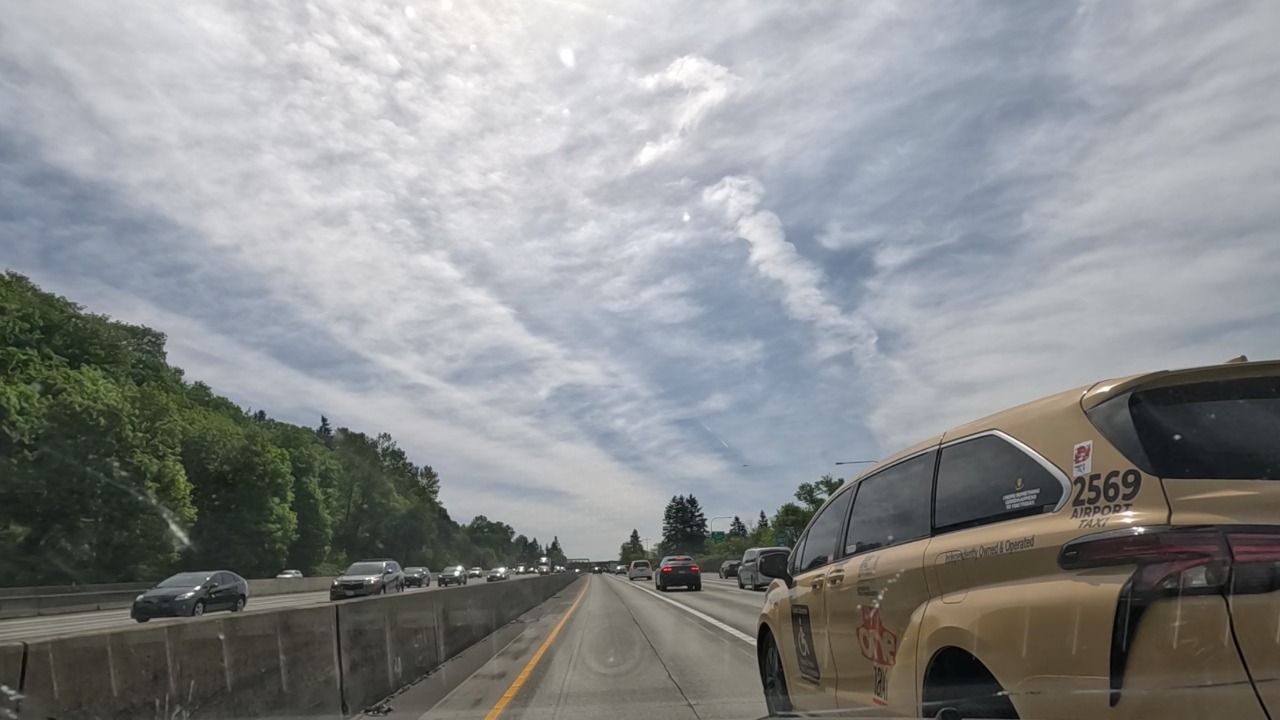
A taxi cut into the I-5 HOV lane near SeaTac with no passenger and nearly caused a crash. (Photo: PNW Daily dashcam)
SEATTLE — An empty taxi trying to enter the HOV lane nearly caused a crash on I-5 near SeaTac Thursday. It turns out the driver had no right to be there.
The HOV lane on Interstate 5 was moving steadily as PNW Daily headed to Seattle-Tacoma International Airport Thursday. When a taxi approached a slower car camping in the passing lane and decided to cut left across the solid white line into the HOV lane and nearly took off our front end.
The driver accelerated away into the general lanes. One person in the cab. No passenger visible.
It raised an obvious question most drivers don’t actually know the answer to: does a taxi get the same pass as a Metro bus? In Washington state, the answer is no; and if that near-miss had gone differently, the insurance question would have gotten complicated fast.
This Crash Report is sponsored by CrashLaw.NET, a legal resource for crash victims in Whatcom County.

Taxis Are Not Buses. The Law Is Clear.
Washington state law lists exactly which vehicles may use HOV lanes without meeting the occupancy requirement: municipal transit buses, vehicles with a capacity of 16 or more passengers, motorcycles, and emergency vehicles.
Taxis and for-hire vehicles are not on that list.
Under RCW 46.61.165 — the statute governing HOV lane use — private transportation providers, which includes taxis, can actually be prohibited from HOV lanes entirely when those lanes fall below the state’s 45 mph performance standard during peak hours.
An empty taxi has no special exemption. It needs a passenger, just like everyone else.
The Violation Numbers Don’t Tell the Whole Story
Washington’s official HOV violation rate sits between 1 and 7 percent, which is well below the national average of 10 to 15 percent, according to WSDOT.
The state credits enforcement by the Washington State Patrol and its HERO tip program, which lets drivers report cheaters by license plate.
But those numbers only capture clear violations. They don’t count the large share of legal HOV users who aren’t actually taking cars off the road.
Research from the Reason Foundation found that as many as three-quarters of HOV lane users are family members traveling together or parents driving kids to school. Those are trips that would happen regardless of whether the lane existed.
Nationally, carpooling fell from nearly 20 percent of commuters in 1980 to under 9 percent in 2019, even as states doubled their HOV lane miles.
Washington Is Changing the System
Washington has been quietly moving away from the old HOV model for years. On I-405 and SR 167, the state converted carpool lanes into Express Toll Lanes: managed lanes where carpools still ride free, but solo drivers can pay a dynamic toll when space is available. Prices shift in real time to keep traffic moving.
I-5 hasn’t made that transition. The corridor near SeaTac still operates under the original HOV rules.
That means fixed occupancy requirements, enforcement to drive compliance, and a visible speed gap that drives the aggressive lane behavior commuters experience every day.
If a Taxi Hits You, the Insurance Question Gets Complicated
A near-miss is one thing. An actual collision involving a taxi raises questions most people aren’t prepared for. The distinction matters because taxi insurance doesn’t work like personal auto coverage. If the company owns the vehicle and employs the driver, the claim goes against the company’s commercial policy.
In those cases you have a claim against the taxi company if they own the vehicle and the driver. Sometimes taxi companies own the vehicle but lease or rent cars to drivers who operate the fleet or just that vehicle, and that lessor will also carry their own commercial policy. Deciding which policy covers the accident can be very technical — I recommend people just ask us so we can assess on a case-by-case basis.
— Ziad Youssef, CrashLaw.NET
But if the driver leases the cab independently, there may be a separate lessor policy in play. If an accident occurs, figuring out which one covers your injuries requires someone who knows how those policies interact.
If you’re in a crash involving a taxi, document everything, preserve any video, and contact an attorney before engaging with any insurance company.
Frequently Asked Questions
PNW Daily brings you this Crash Report as part of the ongoing series sponsored by CrashLaw.NET. If you’ve been seriously injured, give Ziad Youssef and the team a call today at (360) 255-5046.

About the Author





1 thought on “Near Miss: Can an Empty Taxi Use the HOV Lane In Washington?”