

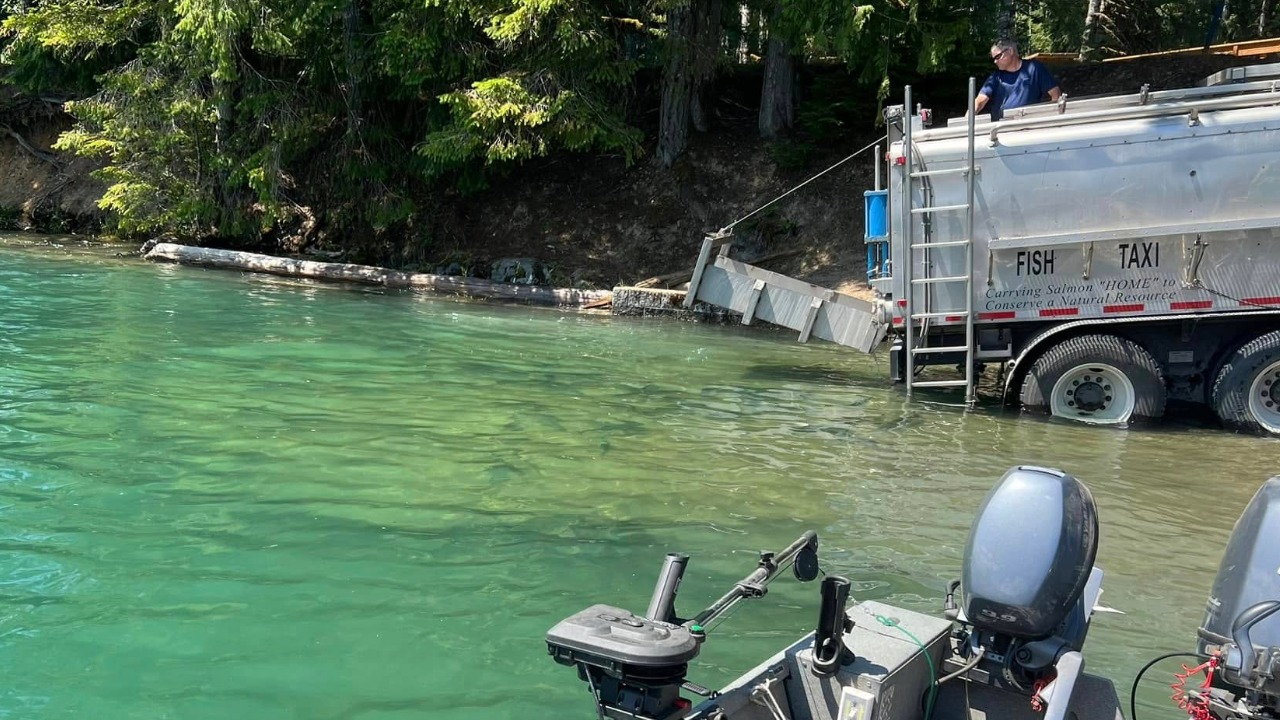
A tanker truck releases sockeye into Baker Lake at the Swift Creek launch on July 13, 2023. Adult sockeye are trapped below the Baker River dams and trucked upstream to the lake each summer as part of the cooperative recovery program between WDFW, the Upper Skagit Indian Tribe, the Swinomish Indian Tribal Community and Puget Sound Energy. (Photo: PNW Daily)
BURLINGTON, Wash. — Columbia River sockeye fisheries are being scaled back across much of Washington after returns fell well below preseason expectations. Anglers willing to adapt still have a wide range of salmon options, from the Skagit Valley to the Pacific Coast.
The Washington Department of Fish and Wildlife announced June 18 that sockeye passage at Bonneville Dam is tracking far below the preseason forecast of 275,000 fish. Several popular Columbia River sockeye fisheries are now closing or being reduced as a result.
The closures are expected to affect anglers across the Pacific Northwest. That includes guides and recreational fishermen who traditionally follow sockeye runs from the lower Columbia to the Upper Columbia each summer.
Some anglers have already expressed concern that displaced effort could shift toward Baker Lake, one of Washington’s most popular and productive sockeye fisheries. Spilt Milt Productions recently warned that pressure on the lake could increase substantially this season.
“I see posts from guides who normally make their living off the Upper Columbia sockeye runs now being forced to shift their operations to Baker Lake,” the fishing content creator wrote. “The pressure on the Baker Lake fishery is going to be extreme this year.”
The pressure on the Baker Lake fishery is going to be extreme this year.
— Spilt Milt Productions
Yet while Baker Lake remains the focus of much of that discussion, it is far from the only salmon opportunity available this summer.
Baker Sockeye Tracking Behind Last Year, But Close To Average
Daily Baker River trap counts remain behind last year’s record-setting return. They are still tracking close to historical averages as the run builds toward its mid-July peak.
According to WDFW trap data, 197 adult sockeye had passed the Baker River trap through June 18. Counts have been climbing through the week:
- June 13: 9 fish
- June 14: 22 fish
- June 15: 22 fish
- June 16: 13 fish
- June 17: 36 fish
- June 18: 71 fish
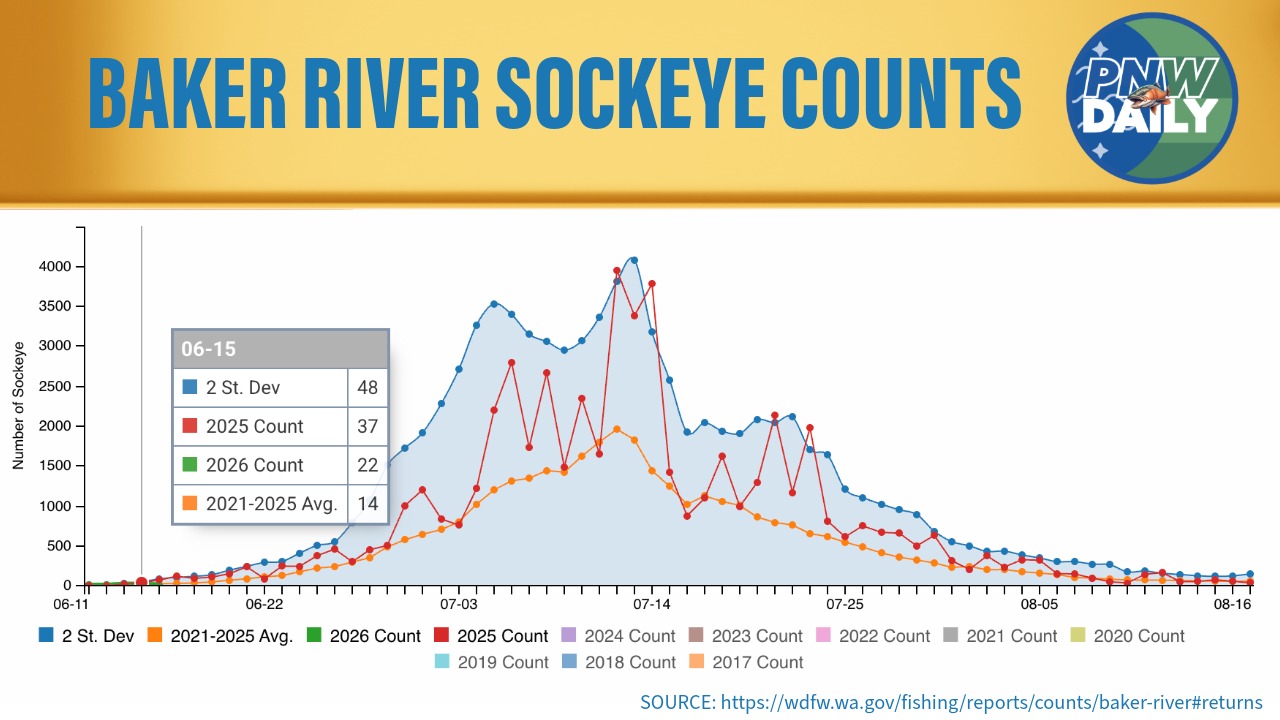
Baker River sockeye trap counts compared to the 2025 record return and recent five-year average. Data Source: WDFW
That June 16 count of 13 fish compares to 70 fish on the same date in 2025, the year Baker Lake produced a record return of nearly 92,000 sockeye. The recent five-year average for June 16 is approximately 22 fish, though, meaning this year’s count sits below average but within the normal range for this point in the run.
The timing matters because Baker sockeye historically do not peak until mid-July, so the bulk of the run has yet to reach the trap near Concrete.
WDFW continues to forecast a 2026 return of 70,861 Baker sockeye, a number 67 percent above the recent 10-year average. If the forecast holds, it would mark another exceptionally strong run despite falling short of last year’s record.
The Baker Lake fishery is scheduled to open July 11 and run through Aug. 31, with a daily limit of four sockeye. WDFW has said the fishery will open as planned regardless of how many fish are already in the lake.
The fishery has become one of the state’s premier salmon opportunities. It has recovered from fewer than 100 returning fish in 1985 to annual returns that now regularly exceed tens of thousands. That recovery is the product of a cooperative management effort involving WDFW, the Upper Skagit Indian Tribe, the Swinomish Indian Tribal Community and Puget Sound Energy.
Lower Skagit Sockeye Fishery Already Underway
For Northwest Washington anglers, the nearest sockeye opportunity is not Baker Lake. Portions of the lower Skagit River are already open for sockeye fishing through July 31.
The fishery allows retention of four sockeye daily, while requiring release of all other salmon species. Several temporary closures will occur June 25-26 and June 30-July 2 to accommodate tribal fisheries.
WDFW also noted that the Baker River access area and boat launch will close during those tribal fishing periods. The lower Skagit fishery gives local anglers a chance to target sockeye weeks before Baker Lake opens.
Hatchery Chinook Fisheries Continue In The Skagit Basin
Sockeye are not the only salmon option in Northwest Washington. Hatchery spring Chinook fishing also continues on the Upper Skagit River from Rockport to Marblemount through July 15, with a four-fish daily limit that includes no more than two adults. The Cascade River remains open too, on Wednesdays through Saturdays through July 15.
Both fisheries opened after managers projected sufficient hatchery returns to meet broodstock needs while still offering recreational opportunity. That gives anglers a local alternative without requiring a trip to Baker Lake.
Pacific Coast Salmon Seasons Open June 20
Some of Washington’s largest salmon opportunities begin June 20 along the Pacific Coast. Neah Bay’s Marine Area 4 opens with a Chinook guideline of 13,110 fish, higher than the 2025 allocation. La Push’s Marine Area 3 follows with a guideline of 2,200 Chinook. Westport and Ocean Shores’ Marine Area 2 opens with a Chinook guideline of 21,910 fish and a coho quota topping 38,000.
Most ocean areas begin with one-salmon limits before expanding to two-salmon limits in July. That gives anglers accustomed to traveling for Columbia sockeye another destination worth considering.
Puget Sound Opportunities Expanding
Additional opportunities are also opening inside Puget Sound. Marine Area 11 around Tacoma and Vashon Island recently expanded from one Chinook to two Chinook daily. Managers made the change after anglers harvested only about 35 percent of the available quota through mid-June.
The move signals that catch rates remain below preseason expectations, with additional fishing opportunity still on the table.
San Juan Islands Fishery Opens July 16
Anglers willing to head into the San Juan Islands will find another opener on the calendar. Marine Area 7 is scheduled to open for Chinook July 16 through July 18, with a daily limit of two salmon including no more than one Chinook. Anglers must release chum, sockeye and wild coho during that window, and WDFW says additional Chinook openings could follow depending on available quota.
The area reopens Aug. 1 through Sept. 30 under a two-fish daily limit, though Chinook must be released for the remainder of the season.
Other River and Deep Water Alternatives Remain Available
Southwest Washington anglers also have options closer to home. The Lewis River opened June 1 for hatchery Chinook retention through July 31, with a daily limit of six salmon including one adult hatchery Chinook.
2026 Salmon Season Quick Reference
- Lower Skagit River sockeye: open through July 31, daily limit 4 sockeye
- Baker Lake sockeye: opens July 11 through Aug. 31, daily limit 4 sockeye
- Upper Skagit Chinook (Rockport to Marblemount): through July 15, daily limit 4 including no more than 2 adults
- Cascade River Chinook: Wednesdays-Saturdays through July 15
- Marine Area 4 (Neah Bay): opens June 20, Chinook guideline 13,110 fish
- Marine Area 3 (La Push): opens June 20, Chinook guideline 2,200 fish
- Marine Area 2 (Westport/Ocean Shores): opens June 20, Chinook guideline 21,910 fish
- Marine Area 11 (Tacoma/Vashon): two-Chinook daily limit through June 30
- Marine Area 7 (San Juan Islands): opens July 16-18, daily limit 2 including no more than 1 Chinook
- Lewis River: open through July 31, daily limit 6 including 1 adult hatchery Chinook
Columbia River Mainstem Below Wenatchee: What’s Open Now
The sockeye shortfall is also reshaping salmon rules on the mainstem Columbia, from the lower river up through the Tri-Cities and toward Wenatchee. Several stretches that allowed limited sockeye retention this week close at the end of the day Friday, while reaches near Priest Rapids Dam stay closed to all salmon through the summer.
- Megler-Astoria Bridge to Bonneville Dam: open through June 26, daily limit 6 including no more than 1 steelhead, release all salmon other than hatchery jack Chinook. Sockeye retention opens June 27-July 5.
- Bonneville Dam to The Dalles Dam: same rules as above, open through June 26 with a sockeye window June 27-July 5.
- The Dalles Dam to Hwy. 395 Bridge at Pasco: open through June 26, same limits, with sockeye retention allowed June 27-July 5.
- Hwy. 395 Bridge at Pasco to Columbia Point: closed to salmon through Sept. 14. Reopens Sept. 15-Oct. 31, daily limit 6 including no more than 1 adult.
- Columbia Point to I-182 Bridge at Richland: open through June 19 only, daily limit 4 sockeye, bank fishing from the Richland shore only. Closes to all salmon retention June 20-July 31.
- I-182 Bridge to 650 feet below Priest Rapids Dam: same sockeye-only rules through June 19, then closed to all salmon retention June 20-July 31.
- Priest Rapids Dam to Chief Joseph Dam: closed to fishing for and retaining all salmon July 1-Aug. 31.
WDFW says select areas upstream of the Hwy. 395 Bridge in Pasco could reopen for retention in July if the Columbia sockeye return improves. The agency is also watching passage at Tumwater Dam, where the Lake Wenatchee sockeye fishery could open if returns sufficiently exceed the 23,000-fish spawner escapement target.
Combined with ocean fisheries, Puget Sound openings, Skagit Basin Chinook fisheries and the upcoming Baker Lake season, Washington anglers still have substantial salmon opportunities despite disappointing Columbia sockeye returns. The challenge for fishery managers may be keeping that effort spread across those opportunities, rather than concentrated on Baker Lake alone.
As Baker sockeye numbers continue building toward their mid-July peak, anglers will be watching closely to see whether another strong run develops, and whether the predicted surge in pressure follows.
Frequently Asked Questions
About the Author


2 thoughts on “Columbia River Sockeye Closure Has Baker Lake Anglers Anxious”