

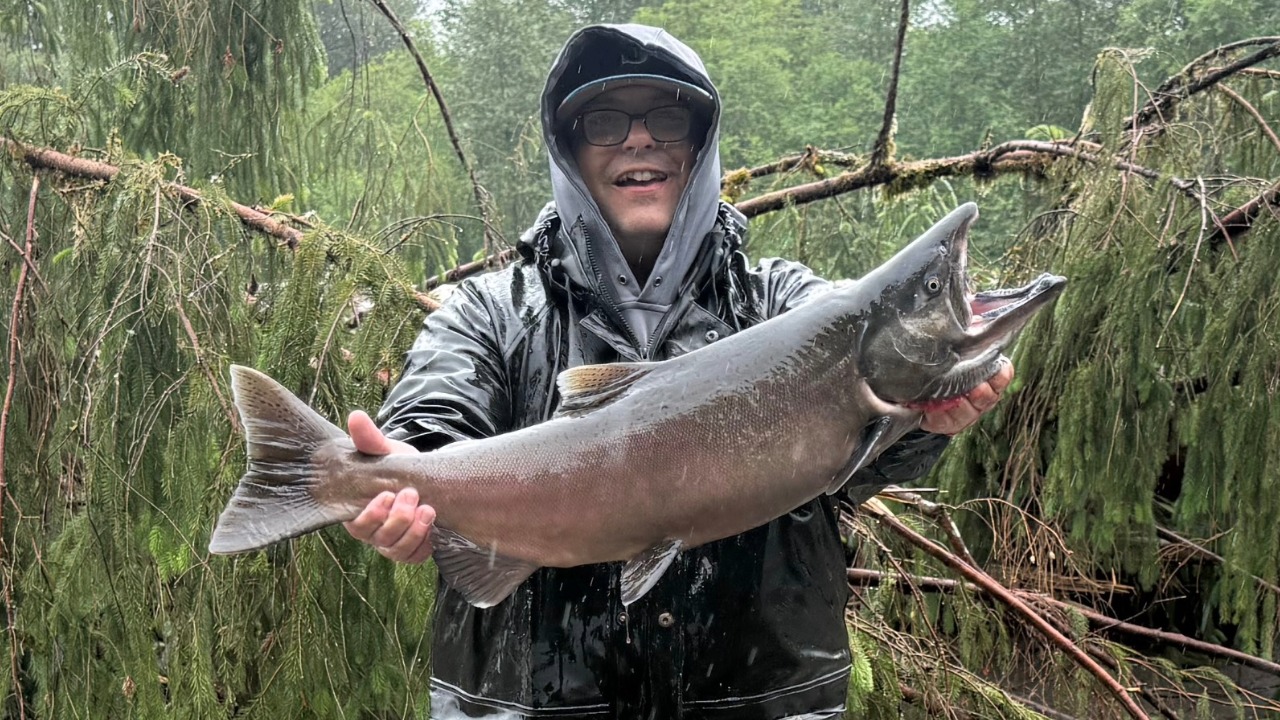
Rainy weather didn't stop anglers from finding success on the North Fork Nooksack River. This hatchery spring Chinook was landed Sunday morning, hours before WDFW announced the fishery would close after exceeding its wild Chinook encounter threshold. (Photo by Brian Henderson / PNW Daily)
OUTDOOR
REPORT
BELLINGHAM, Wash. — A debate erupted across social media this week after the Washington Department of Fish and Wildlife abruptly closed the North Fork Nooksack River hatchery spring Chinook fishery, with some anglers blaming fishing videos, social media exposure and growing crowds for the early closure.
However, new information provided to PNW Daily reveals the closure stemmed from a much smaller conservation threshold than many anglers realized.
WDFW closed the fishery June 9 after determining anglers had exceeded the allowable impact on wild Chinook salmon.
WDFW Explains Closure Threshold
In response to questions from PNW Daily, WDFW spokesperson Chase Gunnell said the allowable impact limit for the fishery was three wild Chinook mortalities.
Washington applies a standard 10% catch-and-release mortality rate to adult salmon and steelhead. That translated the three-mortality limit into 30 allowable encounters with wild Chinook.
WDFW fishery samplers recorded 33 wild Chinook encounters during angler interviews between the May 23 opener and June 8. Those three extra encounters triggered the closure.
“The allowable natural-origin Chinook impacts (or mortalities) for this recreational fishery on the North Fork Nooksack targeting hatchery spring Chinook was 3 wild Chinook,” Gunnell said in an email to PNW Daily.
Small Margin Separates Opportunity From Closure
The numbers reveal a much narrower margin than many anglers discussed online.
Hundreds of wild fish encounters did not drive this closure. WDFW says the fishery exceeded its allowable impact threshold by just three encounters beyond the 30-fish limit — a limit the annual North of Falcon salmon season-setting process establishes each year.
That distinction matters because many commenters assumed heavy harvest or overwhelming fishing pressure forced the closure.
Crowding was evident throughout portions of the season. But WDFW’s explanation ties the closure decision to conservation limits for ESA-listed wild Chinook — not to the number of anglers on the river.
Broader Opportunity Debate Continues
The closure has reignited discussion about fishing opportunity throughout Northwest Washington.
Several anglers argued that concentrated effort on the North Fork reflects a larger problem. As opportunities shrink on other rivers and fisheries, more anglers compete for limited openings when they become available.
Whether social media contributes to that crowding remains a matter of debate.
The math behind this closure is not. WDFW allowed impacts equivalent to three wild Chinook mortalities. Agency samplers documented 33 wild Chinook encounters, exceeding the 30-encounter limit and triggering the closure under the fishery’s management plan.
WDFW’s own 2026 season-setting documentation also speaks directly to the pressure question. In building this year’s Puget Sound marine schedule, fishery managers deliberately aligned several summer hatchery Chinook marine area openings to the same date to spread angler pressure across multiple fisheries. That acknowledgment reflects an understanding that concentrated effort on individual fisheries is a real management concern — and one the agency is actively trying to counter through season design.
Anglers Blame Crowds and Social Media
Following PNW Daily’s coverage of anglers fishing the North Fork Nooksack, some commenters argued that increased attention on the fishery contributed to its closure.
“This kinda post explains why the river is full of guys from Seattle and further south and why the river got closed down so early,” commenter Ryan Visser wrote. “Social media has absolutely destroyed fishing.”
Others pointed to increasing angler pressure across the region.
“Less opportunity packs everyone into a highly watched area,” commenter Aaron Eriksen wrote, arguing that limited fishing opportunities throughout Puget Sound have concentrated anglers into fewer fisheries.
Those comments reflect a long-running debate among anglers over whether social media, fishing reports and online videos contribute to crowding and increased pressure on popular fisheries.
One key point, though: PNW Daily published the footage that prompted some of that criticism after the closure announcement. The video documented anglers fishing after the season had already ended.
The Outdoor Report is sponsored by Yeager’s Sporting Goods, located at 3101 Northwest Avenue in Bellingham.

The North Fork Nooksack is closed until fall. But Washington salmon fishing does not stop because one river did. From saltwater marine areas to the upper Columbia, the calendar is fuller than many Northwest Washington anglers realize.
Here is where the fish are and when the seasons open, now through fall.
COMING SOON: Skagit River Sockeye
The Skagit opens for sockeye June 16 and runs through July 31. The good news is that sockeye are already being transported from the river to the lake, so opening week should see success.
Two sections carry the season. From the Highway 536 Bridge at Mount Vernon upstream to the mouth of Gilligan Creek, and from Gilligan Creek to the Dalles Bridge at Concrete, anglers can keep four sockeye per day. Both sections close July 31. If you want sockeye close to home this summer, mark June 16 on the calendar.
Now Open: Marine Area 5 (Sekiu / Pillar Point)
Marine Area 5 is open for salmon on odd-numbered days through July 31. That means roughly every other day through the end of the month. The return of this Strait of Juan de Fuca fishery was one of the gains for anglers in the 2026 season-setting process. Check WDFW’s emergency rules page before any trip, as in-season adjustments happen quickly.
Now Open: Tulalip Terminal Area (Marine Area 8-2)
The Tulalip Bubble — the hatchery Chinook terminal area in Marine Area 8-2 off Tulalip Bay — is open Fridays and Saturdays through September 7. Daily limit is one hatchery Chinook, 22-inch minimum. Release chum, coho and wild Chinook. The fishery closes once the 600-fish harvest quota is reached, so it could close before September. Confirm the status before loading up the boat.
Now Open: Upper Skagit Hatchery Chinook
The upper Skagit from the Highway 530 Bridge at Rockport to the Cascade River Road at Marblemount is open daily for hatchery spring Chinook through July 15. Limit is four fish including no more than two adults. Anti-snagging rules and night closure apply. The Cascade River from its mouth to the Rockport-Cascade Road Bridge is open Wednesday through Saturday through July 15 under the same rules. After July 15, both sections go to selective gear rules only through mid-September.
July 11: Baker Lake Sockeye Opens
Baker Lake opens July 11 — the first Saturday after July Fourth weekend — for sockeye. Limit is four fish per day. WDFW has confirmed this date opens regardless of trap counts, so check the counts before making the trip to gauge whether it is worth your time. The season runs through August 31. Baker Lake is one of the better family sockeye fisheries in the region and fills up fast on opening weekend.
Mid-July: Marine Areas 7 and 9 Open for Chinook
Marine Area 7 — which includes Bellingham Bay — is scheduled to open July 16 through 18 for summer hatchery Chinook with a harvest quota of 2,181 fish. Marine Area 9 at Admiralty Inlet carries the same tentative window. WDFW intentionally aligned multiple Puget Sound marine Chinook openings this summer to the same date to spread fishing pressure. Both fisheries are quota-managed and could close quickly. The Bellingham Bay terminal fishery opening is notable for local anglers — it carries two additional weeks compared to last year.
Early July: Brewster Pool Sockeye Heats Up
The Brewster Pool on the upper Columbia River, where the Okanogan River joins the mainstem near Brewster, is one of Washington’s best summer salmon fisheries. Sockeye typically begin staging there in the first week of July and peak through early August. The 2026 forecast projects approximately 184,000 Okanogan sockeye bound through the Brewster Pool, part of a larger statewide Columbia River sockeye forecast of 274,900 fish. That is a strong return.
There is no fixed opening date for Brewster sockeye. WDFW sets the season by emergency rule based on real-time dam passage counts at Priest Rapids. Historically the fishery opens in early July and runs into August, Wednesdays through Saturdays. In 2025, a mid-season run-size downgrade tightened the limit to two sockeye. With a stronger forecast in 2026, managers could allow a higher limit — but that depends entirely on what the fish actually do. Watch for WDFW emergency rule announcements in late June. The Fish Washington mobile app is the fastest way to catch updates.
Brewster is a four-to-five hour drive from Bellingham, but anglers from across the Northwest make the trip every summer. The fishery also produces summer Chinook later in the season.
August 1: Northwest Washington Reopens
August 1 is the next meaningful local salmon date for Whatcom and Skagit County anglers. Three fisheries open on the same day.
The Nooksack River mainstem from the Lummi Reservation boundary up to the FFA High School barn in Deming opens August 1 through September 30 for a limit of six fish including no more than two hatchery Chinook, two wild coho and two chum. Wild Chinook must be released. Night closure and anti-snagging rules apply.
Whatcom Creek from its mouth to the footbridge below Dupont Street opens August 1 on Saturdays and Sundays only through September 27. Limit is two hatchery Chinook. Release all other salmon. This is a weekends-only urban fishery with limited space but consistent hatchery returns.
The Samish River from its mouth at Bayview Edison Road to the Thomas Road Bridge opens August 1 through September 30 for two Chinook per day. Stationary gear rules apply, single-point hook only, and the use of eggs is required. Release wild coho and chum. Special events include a Youth Fishing Day on September 5 and a Veterans and Active Military Fishing Day on September 6, both focused on the Bayview Edison Road Bridge section.
August 16: Skagit Coho Season Begins
Skagit River coho seasons open August 16 on multiple sections from the river mouth upstream to Rockport. Limits are four coho per day with no more than two wild fish. The fishery runs through October 31, with potential extensions based on in-season run-size updates.
This is historically one of the more popular fall salmon fisheries in Northwest Washington.
Fall: Nooksack FISHING Returns
Nooksack mainstem (Lummi IR boundary to FFA High School barn in Deming), Aug. 1-Sept. 30: Daily limit 6 including no more than 2 wild coho, 2 chum and 2 hatchery Chinook. Release wild Chinook. So chum IS retainable there, limit 2. The calendar text had it right.
South Fork Nooksack (mouth to Skookum Creek): Opens Oct. 1-Oct. 15, limit 6 including no more than 2 wild coho or 2 hatchery Chinook. Release chum and wild Chinook. Oct. 16-Dec. 31 the chum release requirement drops and the limit becomes 2 wild coho or 2 Chinook.
North Fork Nooksack from Highway 9 to Kendall Creek reopens for salmon October 1.
The fall fishery targets coho and does not carry the ESA wild Chinook constraints that govern the spring hatchery Chinook season. Limit is six fish including no more than two wild coho or two hatchery Chinook.
A Note on All These Seasons
Every date and limit listed here comes from WDFW’s 2026-2027 proposed season package and is subject to change. The final 2026-2027 sport fishing regulations pamphlet is expected online around June 18. Printed copies should reach license dealers and WDFW offices around June 26. The Fish Washington mobile app updates in real time for emergency rule changes. Check before every trip. In-season adjustments, closures, limit reductions, and added days happen fast and happen often.
The full proposed season documents are available at wdfw.wa.gov/fishing/management/north-falcon/summaries.
| When | Where | Species / Notes |
|---|---|---|
| Now through July 31 | Skagit River (Mt. Vernon to Concrete) | Sockeye, limit 4 |
| Now through July 31 (odd days) | Marine Area 5 (Sekiu / Pillar Point) | Chinook, alternating days |
| Now through Sept. 7 (Fri/Sat only) | Tulalip Terminal Area (MA 8-2) | Hatchery Chinook, limit 1, quota 600 |
| Now through July 15 | Upper Skagit / Cascade River | Hatchery Chinook, limit 4 (2 adults) |
| July 11 through Aug. 31 | Baker Lake | Sockeye, limit 4 |
| July 16-18 (quota-managed) | Marine Area 7 (Bellingham Bay / San Juans) | Hatchery Chinook, quota 2,181 |
| July 16-18 (quota-managed) | Marine Area 9 (Admiralty Inlet) | Hatchery Chinook |
| Early July through Aug. (emergency rule) | Brewster Pool, Upper Columbia | Sockeye, limit TBD by run size; 184K forecast |
| Aug. 1 through Sept. 30 | Nooksack River Mainstem | Chinook, coho, chum; limit 6 |
| Aug. 1 through Sept. 27 (weekends) | Whatcom Creek | Hatchery Chinook, limit 2 |
| Aug. 1 through Sept. 30 | Samish River (mouth to Thomas Rd.) | Chinook, limit 2; eggs required |
| Aug. 16 through Oct. 31 | Skagit River (mouth to Rockport) | Coho, limit 4 (2 wild max) |
| Oct. 1 through Nov. 30 | North Fork Nooksack (Hwy. 9 to Kendall) | Coho / Chinook fall season reopens |
All seasons subject to change. Verify current rules at wdfw.wa.gov/fishing/regulations or via the Fish Washington mobile app before every trip. Emergency rule changes can occur without advance notice.
Frequently Asked Questions
PNW Daily brings you The Outdoor Report as part of an ongoing series sponsored by Yeager’s Sporting Goods.

About the Author


1 thought on “Outdoor Report: WDFW Explains Nooksack Chinook Closure”