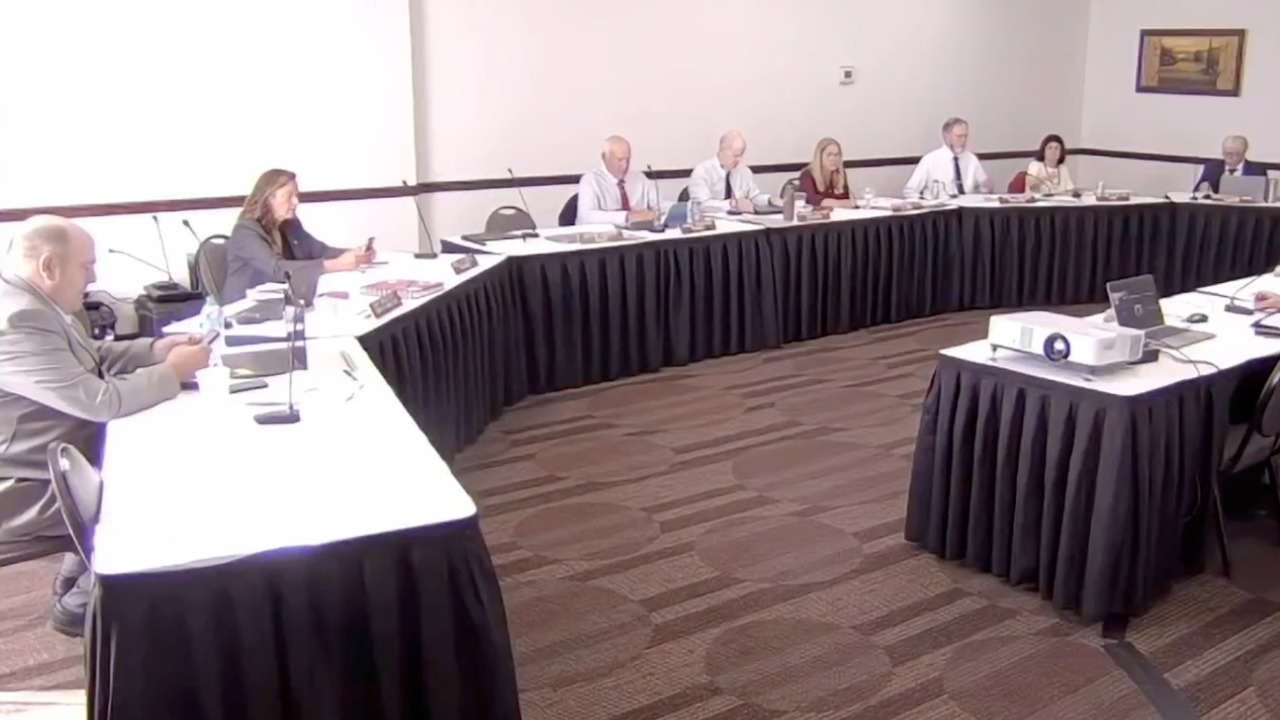
A WDFW Commission investigation found secret meetings, missing public records and private coordination on policy, motions and votes. Commision members are seen here as meet to discuss wildlife management. (Photo: Courtesy TVW)
OLYMPIA, Wash. — A governor-ordered investigation found Washington Fish and Wildlife commissioners violated the state’s open-meetings law by privately coordinating public business, including policy language, motions, votes and commission leadership.
The 68-page report also found commissioners withheld public records, used personal devices for state business and repeatedly met with organizations actively suing the Washington Department of Fish and Wildlife.
Those organizations and commissioners shared a recognizable policy objective: moving WDFW away from management centered on hunting, trapping, hatchery production and harvest opportunity.
Meanwhile, Washington quietly eliminated funding for the monitoring required to open the Skagit and Sauk wild steelhead season. The fishery remained closed in 2026 despite a forecast large enough to support limited catch-and-release fishing.
“The evidence establishes that commissioners engaged in serial meetings that violated the Open Public Meetings Act,” investigator Chiedza Nziramasanga wrote.
WDFW issued only a brief statement after receiving the final report from Gov. Bob Ferguson’s office July 28.
“WDFW is reviewing the report and awaiting further information from the governor’s office.”
WDFW STATEMENT ON FINDINGS
Public Business Conducted in Private
Transformative Workplace Investigations examined five categories of allegations involving members of the nine-person Washington Fish and Wildlife Commission.
The investigation substantiated in part allegations involving violations of the Public Records Act, Open Public Meetings Act and commission ethics rules. It also substantiated parts of allegations involving mistreatment of WDFW employees and retaliation against Director Kelly Susewind.
An allegation involving Commissioner Lorna Smith’s compensation claims was not substantiated.
The investigator concluded that commissioners held serial meetings through overlapping private conversations. Although fewer than five commissioners participated in individual exchanges, information moved between groups until a majority became involved.
Under Washington law, a governing body can violate the Open Public Meetings Act through a series of communications involving a majority, even when a quorum never joins the same call, email or meeting.
The report found commissioners went beyond simply gathering information.
“Commissioners discussed how to structure motions, anticipated voting outcomes, and coordinated support for leadership positions prior to public meetings — active coordination on agency business, not merely passive preparation,” Nziramasanga wrote.
The private exchanges included text messages, emails, telephone calls, Zoom meetings and gatherings with outside advocates.
Shared Agenda Extended Beyond One Decision
The commissioners repeatedly met with Washington Wildlife First, Wild Fish Conservancy and The Conservation Angler.
Those organizations share a broad effort to reform WDFW policy around wildlife protection and wild-fish conservation. Their work includes ending spring bear hunting, restricting cougar hunting and lethal wolf removal, limiting trapping, reducing hatchery influence and imposing stronger restrictions on fisheries that affect wild salmon and steelhead.
Washington Wildlife First has described its objective as transforming WDFW into an agency that prioritizes conservation over “consumption.” The organization advocates moving the department away from its historic focus on hunting, fishing and harvest opportunity.
Wild Fish Conservancy promotes “sunsetting hatcheries” and has pursued litigation challenging state hatchery programs. The Conservation Angler advocates greater protections for wild salmon and steelhead, including restrictions on hatchery practices and fisheries it considers harmful to naturally produced fish.
Holding those positions is not misconduct. Privately coordinating public policy and votes with aligned organizations while failing to disclose the meetings is at the center of the investigation’s findings.
Scheduling records showed Smith appeared in 40 meetings with the organizations between January 2022 and January 2025. Commissioner Melanie Rowland appeared in 37, Commissioner John Lehmkuhl in 28 and Commissioner Woody Myers in 13.
Claire Loebs Davis, an attorney and Washington Wildlife First leader, was identified as a scheduled attendee at approximately 20 meetings while she or organizations associated with her had cases pending against WDFW.
The meetings covered spring bear hunting, cougar petitions, wolf rules, hatchery reform, the Game Management Plan, conservation policy and commission leadership.
Smith acknowledged meeting regularly with an advocate, sometimes approximately once a week. She also acknowledged that the communications influenced her thinking.
The investigator found that many contacts were not disclosed to other commissioners or WDFW attorneys as required.
Spring Bear Vote Triggered Records Battle
The controversy began with the commission’s debate over recreational spring black bear hunting.
Smith, Rowland, Lehmkuhl and former Commissioner Tim Ragen privately discussed the spring hunt through emails and Zoom meetings. Members referred to themselves as the “Gang of Four,” although the report said the composition changed at different times.
The four shared Washington Wildlife First’s opposition to the hunt.
Smith acknowledged that the group agreed on the substance of a motion before the public meeting. The motion then went to Commission Chair Barbara Baker under what commissioners called a “no surprises” practice.
That communication brought a fifth commissioner into the chain before the public meeting.
On Nov. 18, 2022, the commission voted 5-4 to establish a policy against recreational spring bear hunting.
During the meeting, Rowland received a text from an outside person suggesting language for the pending motion. Public comment had already ended. Rowland disclosed the message and proposed an amendment based on the language.
A subsequent public-records request sought the text.
WDFW leaders told the investigator that Rowland initially denied possessing it, said it had been deleted and declined to produce it. The Governor’s Office eventually sent a letter warning that failure to comply could result in her removal.
Rowland’s husband later found the message on her phone, and she provided a screenshot.
The episode helped trigger broader public-records requests from the Sportsmen’s Alliance. One September 2023 request sought years of correspondence among commissioners.
Smith and Rowland did not produce responsive records from their personal accounts for approximately 18 months. Both filed declarations in March 2025 acknowledging they had responsive records.
An internal WDFW memorandum said Rowland told assistant attorneys general she had decided not to respond until she was “forced to.”
The investigator called that admission “direct evidence of intentional noncompliance” with that request.
Returned Computer Exposed Missing Communications
The scope of the conduct became clearer after Ragen left the commission and returned his state computer.
WDFW employees reviewing the device found emails, screenshots, calendars and other records documenting communications that had not appeared in earlier public-record responses.
The records included private conversations about commission votes, leadership, motion language and meetings with outside organizations.
Some messages included instructions to delete information.
In one exchange, Baker wrote, “Ruth is going to talk to our rogue commissioners after tomorrow to let them know all of this is very disappointing to the gov. And… delete. (‘D’ from now on).”
Other records included the phrases “Please delete” and “I probably shouldn’t have sent you Lorna’s voicemail. Please keep it to yourself.”
Baker said some references concerned personal matters. Nevertheless, the investigator found that the use of deletion shorthand during discussions about commission business raised legitimate record-retention concerns.
The investigator did not conclude that every missing record resulted from deliberate or coordinated concealment. Delayed state equipment, inconsistent training and unusually large requests also contributed.
However, the report found incomplete searches, inaccurate declarations, resistance to producing records and at least one admitted instance of intentional noncompliance.
Hatchery Policy Discussed With WDFW Litigants
The private contacts extended into fisheries policy and active litigation.
Wild Fish Conservancy and The Conservation Angler sued WDFW over expanded hatchery Chinook production associated with the Orca Prey Initiative. The case challenged programs intended to produce more Chinook for Southern Resident killer whales while also supporting tribal and recreational fisheries.
The disputed production included hatcheries serving the Nooksack, Samish, Skagit, Snohomish, Olympic Peninsula and Willapa Bay regions.
The report found Davis sent emails about the Chinook State Environmental Policy Act case to the personal accounts of Ragen, Rowland and Smith in August and September 2023. She also sent Smith two emails about active litigation in 2021.
The investigator did not find sufficient evidence that commissioners disclosed confidential legal strategy or coordinated legal arguments with WDFW’s opponents.
However, the repeated contacts created what the report called “appearance concerns and institutional risk.”
The most direct budget connection came when commissioners considered hatchery maintenance funding.
Deputy Director Amy Windrope told the investigator that commissioners had several opportunities to discuss the proposed funding publicly without objecting. Some commissioners then met with Wild Fish Conservancy one day before a key budget vote.
They subsequently opposed the hatchery maintenance line item in a manner consistent with the organization’s litigation position.
The investigator did not label that sequence unlawful collusion. However, it was cited as evidence of undisclosed policy shaping involving organizations litigating against the department.
Skagit Steelhead Season Lost Despite Fishable Return
The clearest indication of the intention to move away from recreational fishing came on the Skagit River in 2026.
WDFW and tribal co-managers forecast 4,557 wild steelhead would return to the Skagit Basin in 2026. That was above the 4,001-fish threshold necessary to consider a limited season under the federally approved management plan.
Nevertheless, the Skagit and Sauk rivers did not open for their celebrated winter and spring catch-and-release fishery.
The reason was not a lack of fish. Washington failed to fund the monitoring and enforcement required under the federal Endangered Species Act permit.
Operating the season requires creel sampling, angler interviews, spawning surveys, estimates of encounters and mortality, in-season run tracking and enforcement patrols.
WDFW estimated it needed at least $350,000 to operate the Skagit-Sauk season. A broader $1.6 million request would have supported Puget Sound salmon and steelhead monitoring across several watersheds.
The Legislature did not include the funding in the 2025-27 operating budget signed by Ferguson.
WDFW also did not propose a subsequent funding package capable of supporting a 2027 Skagit-Sauk season, according to an agency spokesperson quoted by Northwest Sportsman.
The eliminated program supported monitoring in the Skagit, Nooksack, Samish, Stillaguamish and Snohomish watersheds. It also advanced sonar and video fish-counting systems for the Skagit, Samish and Nooksack rivers.
The 2025 Skagit-Sauk fishery generated an estimated 11,222 angler trips and $2.33 million in regional spending. The previous season generated approximately 9,389 trips and $1.97 million.
Both estimates exceeded the entire $1.6 million regional monitoring request.
The commission investigation does not establish that commissioners privately arranged the Skagit funding cut. It does reveal an institution whose governing body coordinated with organizations advocating fewer hatcheries and tighter harvest restrictions while a sustainable, federally permitted recreational fishery was allowed to disappear.
Washington did not lose the 2026 Skagit steelhead season because it ran out of steelhead. It lost the season because state leaders chose not to fund the work required to count and monitor them.
Commissioner Now Suing WDFW Leadership
Most of the officials named in the investigation remain in positions of authority.
Smith remains a commissioner through Dec. 31, 2026. In April, she joined Washington Wildlife First and Davis in filing a federal civil-rights lawsuit against Susewind and Windrope.
The lawsuit creates an extraordinary ongoing conflict.
Smith is a sitting commissioner suing the director she helps supervise. She is also suing the deputy director who supplied evidence to the investigation. Her co-plaintiffs include the organization and advocate at the center of the report’s conflict concerns.
Rowland also remains a commissioner through Dec. 31, 2026. The investigator found direct evidence that she intentionally refused to comply with one public-records request until compelled.
Lehmkuhl remains a commissioner through Dec. 31, 2026. He acknowledged participating in private Zoom discussions about the spring bear decision.
Baker remains a commissioner through Dec. 31, 2028.
Myers remains a commissioner through Dec. 31, 2028. Although he participated in meetings with Washington Wildlife First, he told the investigator that he eventually distanced himself from the organization because he felt uncomfortable with pressure over how he should act or vote.
Ragen is no longer on the commission. Ferguson withdrew his reappointment in early 2025, and Victor Garcia of Skagit County replaced him.
Ragen was not interviewed for the investigation even though his name appears nearly 60 times and records recovered from his computer helped expose the private communications.
Susewind remains WDFW director, while Windrope remains deputy director.
Ferguson Must Decide Whether Anyone Faces Consequences
The report did not recommend specific punishment.
Instead, it advised the Governor’s Office to consult legal counsel and consider the full record before taking formal corrective action.
Ferguson has the authority to remove commissioners for misconduct, malfeasance or incompetence. The Sportsmen’s Alliance petitioned him in May 2025 to remove Smith, Rowland, Lehmkuhl and Baker.
Three of their terms expire at the end of this year. Allowing those terms to lapse would avoid a public removal fight but would not answer whether proven violations warrant consequences.
Baker could remain on the commission through 2028. Meanwhile, Smith continues serving while suing WDFW’s two highest-ranking administrators alongside the advocacy organization whose private access helped prompt the investigation.
The report leaves Washington with a question larger than any single bear hunt, hatchery or fishing season.
The issue is whether the public can trust decisions presented as open deliberation when motions, policies, leadership choices and budget positions were developed through communications the public could not see.
The investigation found that it could not.
Frequently Asked Questions
Smith, Rowland and Lehmkuhl remain in office through Dec. 31, 2026. Baker and Myers have terms extending through Dec. 31, 2028. Ragen is no longer a commissioner.
Yes. Washington law allows the governor to remove Fish and Wildlife commissioners for misconduct, malfeasance or incompetence. The investigation did not recommend specific punishment, leaving Ferguson to decide whether corrective action is warranted.
About the Author