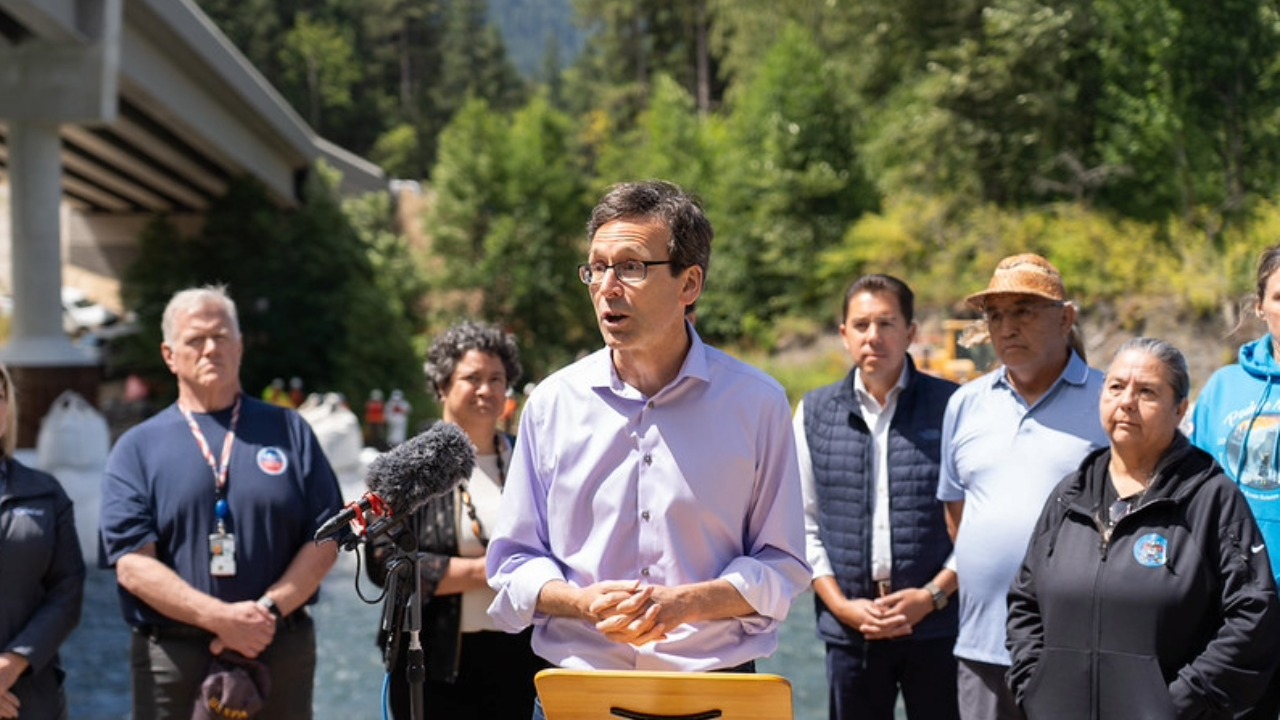
Governor Bob Ferguson visits the site of an accident on Highway 101 near the Elwha River Bridge alongside Ecology Director Casey Sixkiller during a media briefing. (Photo: “Indian Creek Spill Response” by Governor Bob Ferguson)
OLYMPIA, Wash. — Gov. Bob Ferguson and the Washington State Department of Ecology on Wednesday launched Washington’s Water Future, a statewide initiative that will convene regional roundtables to identify water supply solutions and shape policy proposals ahead of the 2027 legislative session.
The launch comes as Washington enters its fourth consecutive year of statewide drought, and state leaders say the moment demands a more permanent response than emergency declarations alone.
“We have some of the best water supply in the nation because the generations before us had the foresight to protect it, but climate change is jeopardizing that,” Ferguson said. “We need to work together now to plan for the future.”
What the Roundtables Will Do
Ecology will host a series of regional roundtables with local and Tribal governments, industries, utilities, environmental groups and community groups. The goal is to hear about their successes and challenges managing water supply, then translate that experience into concrete policy recommendations. Ecology will deliver those recommendations to the governor before the next legislative session.
Already, communities across Washington are pursuing solutions on their own. Some are capturing and storing water underground, pursuing novel conservation methods, and reclaiming wastewater for outdoor irrigation. However, many financial and regulatory barriers currently block broader adoption of those approaches. The roundtable process aims to clear those barriers through efficient and targeted policy changes.
“We can see climate change happening all around us, and it’s reshaping our way of life,” Ecology Director Casey Sixkiller said. “Now is the time to be bold and come to the table. We need to work together to identify creative solutions that can help us prepare for the next 100 years.”
Why Snowpack Is No Longer a Reliable System
The urgency behind the initiative reflects a fundamental shift in how Washington’s water system works. Historically, deep mountain snows accumulated over winter and gradually melted through spring and summer, filling streams, rivers and reservoirs. That model no longer holds. Washington received close to normal precipitation this past winter, but too much of it fell as rain. As a result, the state entered spring with roughly half of its usual snowpack.
Without sufficient snowpack, rivers run low earlier, water temperatures climb, and fish face harsh conditions. Wildfire risk rises as the landscape dries out ahead of schedule. In some agricultural regions, growers may reduce irrigation or leave fields unplanted this summer. The latest climate projections from the University of Washington Climate Impacts Group indicate conditions will worsen in coming decades, affecting both eastern and western Washington.
Karin Bumbaco, deputy state climatologist with the Washington State Climate Office at the University of Washington, warned in April that the problem went deeper than just a shortage of snowpack.
“Even the heavy snowfall in mid-March was not enough to make up multiple months of poor snowpack growth, and early spring warmth has melted much of those gains,” she said. “The weather progression this winter has lined up to deliver very challenging conditions going into spring and summer.”
Bumbaco also noted the underlying temperature driver.
“Precipitation has been basically normal when averaged statewide, but it’s been really warm,” she said. “After our warmest December on record, we finally began to build snowpack in early January before an extended mid-winter dry spell through early March stopped snow accumulation in its tracks.”
State climatologists note that snow droughts now occur about 40 percent of the time, compared to roughly one in five years in the 1990s. By the 2050s, researchers project seven out of every 10 years will see snow droughts on average.
This is our water and our future that we’re talking about. We are compelled to do this for today, but also for those who come after us.
— Ecology Director Casey Sixkiller
Political Divide Over Solutions
Republican lawmakers have responded with skepticism, arguing the state focuses too heavily on conservation and regulation. GOP leaders continue to push for expanded water storage infrastructure including reservoirs and dams as a more direct way to increase supply.
They have also tied water policy to broader affordability concerns, warning that regulatory-heavy approaches could raise costs for residents and businesses.
The divide reflects a broader debate in Olympia over whether Washington should manage scarcity through conservation and policy or increase supply through large-scale infrastructure.
What Happens Next
The Department of Ecology will compile roundtable recommendations and deliver them to the governor before the 2027 legislative session. In the meantime, major metro water systems including Seattle, Tacoma and Everett planned ahead for drought conditions and do not anticipate immediate shortages for their customers. Ecology is making up to $3 million available in drought emergency response grants to eligible public entities.
“Water is a precious resource,” Sixkiller said. “We need to plan ahead and work together so that we’re ready for a warmer future.”
Frequently Asked Questions
About the Author