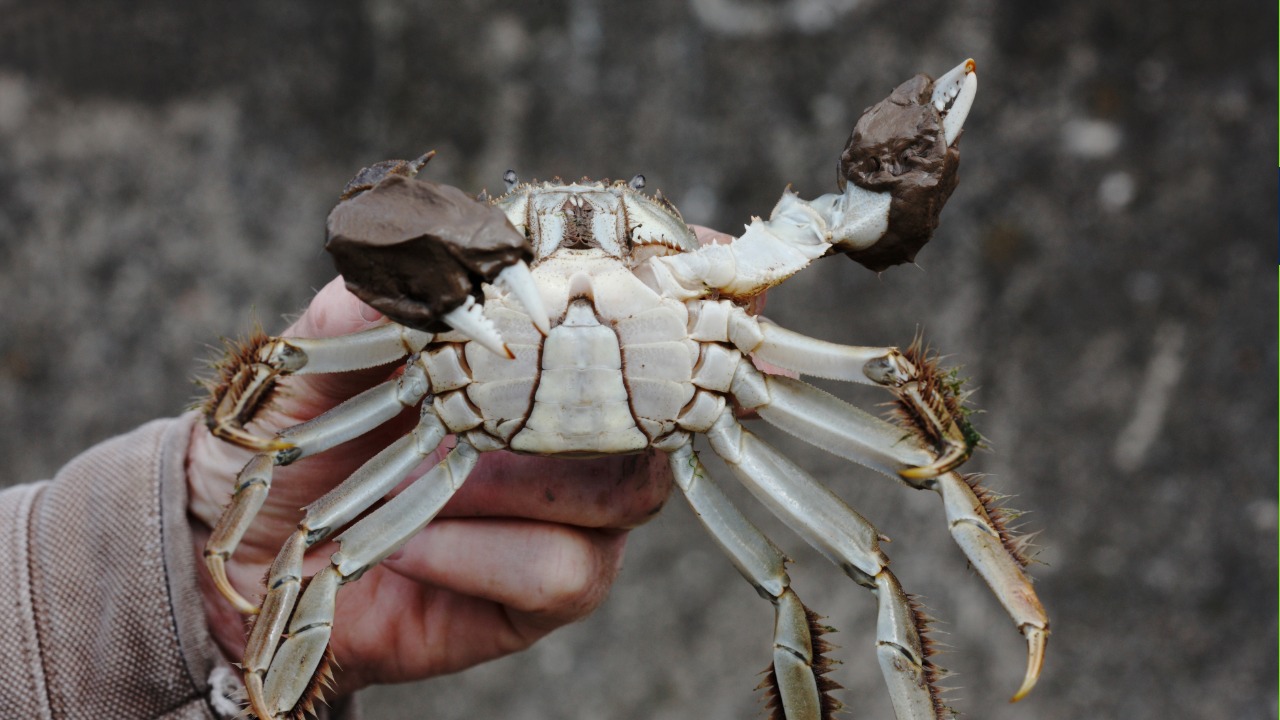
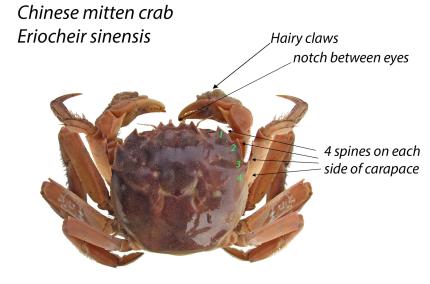
A Chinese mitten crab shows the dense, hair-covered claws that give the invasive species its name.
OLYMPIA, Wash. — Washington wildlife officials are warning the public about invasive mitten crabs after a Washington resident pleaded guilty to illegally selling live crabs to state Fish and Wildlife officers.
The Washington Department of Fish and Wildlife Police investigated the case, while the Washington Attorney General’s Office prosecuted it. The individual sold officers a dozen live mitten crabs between 2023 and 2024.
The person will complete community service, pay restitution and serve probation as part of the case.
Mitten crabs do not currently have an established population in Washington waters. However, state officials say the invasive species could threaten native wildlife and damage waterways if they establish a population.
“Mitten crabs pose a danger to Washington’s economy and ecosystem, particularly our salmon populations. Trafficking in these invasive species is harmful and illegal.”
Nick Brown, Washington Attorney General
Mitten crabs are illegal in Washington
Washington prohibits people from possessing, buying, selling or distributing mitten crabs.
Washington Administrative Code 220-640-030 classifies all members of the Eriocheir genus as prohibited level 1 species.
The crabs can reproduce in large numbers. Females can produce hundreds of thousands of eggs, and some can produce more than 1 million.
Mitten crabs spend much of their lives in freshwater but reproduce in saltwater or estuaries. They can also travel overland, making them difficult to contain after they establish a population.
The species originated in China and South Korea and gets its name from the patches of hair covering its claws.
Why officials are concerned
Chinese mitten crabs can prey on native clams, mussels and fish eggs while competing with native species for food and habitat.
The crabs also burrow into stream banks and levees. Those burrows can increase erosion and damage natural and man-made structures.
Large populations can interfere with fishing gear, fish screens, water infrastructure and other facilities.
The species can also carry the Oriental lung fluke, a parasite that can infect people who eat infected crabs raw or undercooked.
Oregon officials have found mitten crabs in the Lower Columbia River and Willamette River. Officials detected the species in the Lower Columbia River in April 2025 and the Willamette River in November 2025.
WDFW continues to monitor Washington waters for the invasive species.
Invasive species can enter new waterways through several pathways, including ballast water from cargo ships. Chinese mitten crabs have also entered the United States through intentional smuggling and illegal introductions.
“Preventing the introduction of invasive species requires more than identifying them after they become established; it requires stopping illegal pathways before they can lead to an introduction.”
Brad Rhoden, WDFW Police Captain
Rhoden said the investigation disrupted an illegal sales pathway before the crabs could potentially reach Washington waters and establish a population.
What to do if you find a mitten crab
WDFW asks the public not to purchase, possess, transport or release live mitten crabs in Washington.
Anyone who believes they have found a mitten crab should take a photo and report the sighting to WDFW.
Reports can go to 1-888-WDFW-AIS or ais@dfw.wa.gov. The public can also report sightings through the Washington Invasive Species Council’s reporting form or mobile app.
People with information about illegal trafficking of plants or animals can make a confidential report to the WDFW poaching hotline at 877-933-9847 or text a tip to 847411.
Mitten crabs are light brown to green with white-tipped claws. Their carapace can reach about 3 inches wide, while their claws can reach about 1 inch wide.
The species has a notch between its eyes, four spines on each side of its shell and legs more than twice as long as the width of its body.
Young mitten crabs may not have the distinctive hairy claws, particularly when they measure less than three-fourths of an inch across.
Washington officials continue to monitor the state’s waters, where they have not confirmed an established mitten crab population.
Frequently Asked Questions
About the Author