

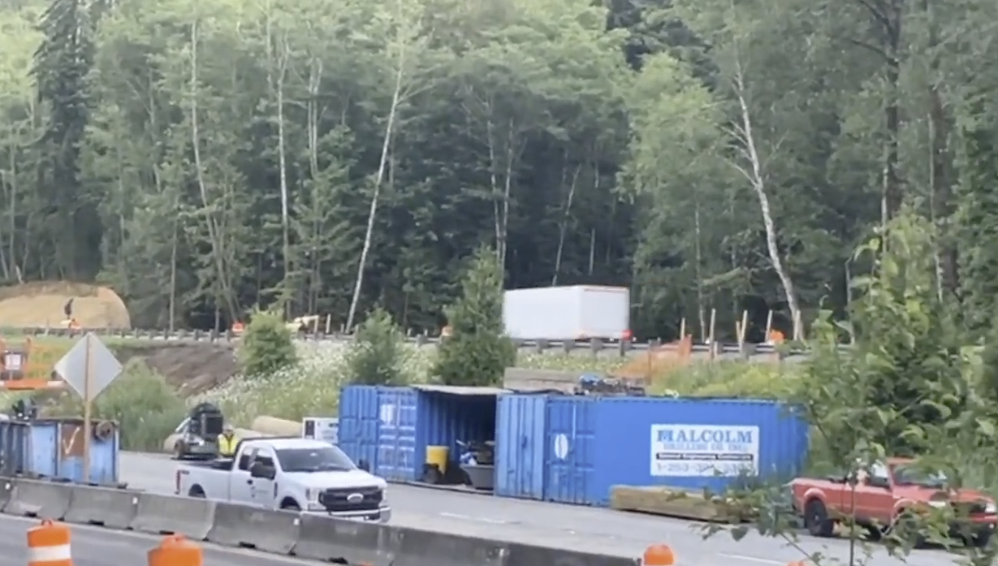
A two-vehicle crash involving a water attenuator truck on northbound I-5 near Lake Samish on June 23 sent both drivers to St. Joseph Medical Center near an active WSDOT construction zone. (Photo: WSDOT)
BELLINGHAM, Wash. — A temporary Interstate 5 traffic configuration south of Bellingham has been the site of a growing number of crashes since construction began, including rollovers, motorcycle crashes and collisions that sent multiple drivers to the hospital.
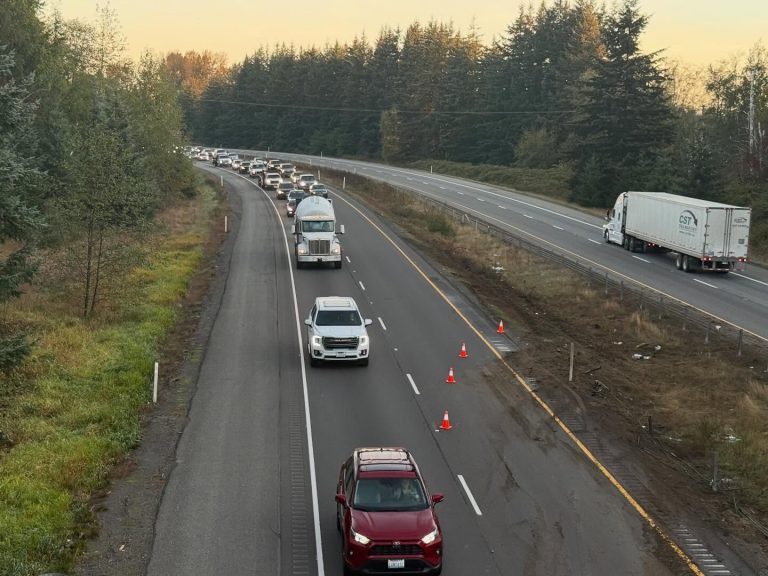
The latest crash came Tuesday afternoon, when a collision on northbound I-5 at North Lake Samish Road blocked the right lane and backed up traffic for more than 2 miles. Washington State Patrol responded to the scene as traffic moved through the active construction corridor.
This Crash Report is sponsored by CrashLaw.NET, a legal resource for crash victims in Whatcom County.

The crashes have occurred along the I-5 corridor between roughly mileposts 245 and 247, where Washington State Department of Transportation crews are building new fish-passage structures near Lake Samish and Chuckanut Creek.
A review by PNW Daily has identified at least 11 crashes in and immediately around the active construction corridor since the traffic shifts began, including seven crashes documented by the Washington State Patrol during one week in June. The count includes a crash PNW Daily documented Sunday that cleared quickly and did not generate a prolonged WSDOT traffic alert.
Seven crashes in one week
The most significant cluster came June 19-25, shortly after traffic was shifted onto temporary bypass roads around the Chuckanut Creek construction area.
WSP reported seven crashes during that one-week period.
The incidents included multiple vehicle collisions, barrier strikes, two rollovers and a motorcycle crash.
One of the rollovers occurred June 24 near milepost 246 after an 83-year-old Elma man failed to merge through the construction zone, struck a barrier and rolled his Hyundai Kona onto its roof.
The driver was transported to Harborview Medical Center in Seattle. His passenger was taken to PeaceHealth St. Joseph Medical Center in Bellingham.
PNW Daily reported at the time that it was the second injury crash in the same corridor in 24 hours.
The previous evening, a two-vehicle crash involving a WSDOT water attenuator truck sent both drivers to St. Joseph Medical Center.
That crash occurred at approximately 5:05 p.m. June 23 near milepost 246.
The June 24 rollover prompted an extended closure of northbound I-5. WSP said the primary cause was failure to merge, and investigators found no evidence that drugs or alcohol contributed to the crash.
Crashes continued after the June cluster
The incidents did not stop after the initial seven-crash period.
WSDOT has continued reporting collisions around milepost 246 and the Lake Samish interchange during the summer.
A northbound collision Aug. 27 partially blocked the right lane near milepost 246. Another collision was reported Saturday, August 29. PNW Daily was traveling north on I-5 Sunday, August 30, and was on the scene of a group of motorcycles in the right lane helping up a bike that had appeared to have made it to the center of the traffic revision and slid.
Then, yesterday’s crash, produced a backup of more than two miles while WSP worked the scene.
The lane eventually reopened, but the incident again demonstrated how quickly a crash in the constrained corridor can create major delays.
The construction configuration is different from a normal freeway
The Chuckanut Creek project has required WSDOT to move traffic onto temporary roads while crews build new fish-passable structures beneath I-5.
WSDOT lowered the temporary speed limit to 50 mph when the bypass was placed into service. The temporary configuration uses lane shifts, barriers and narrowed travel lanes around the construction area.
The project covers several fish-passage locations between mileposts 241 and 247, including Lake Creek at milepost 245, an unnamed tributary near milepost 246 and Chuckanut Creek at milepost 247.
That does not establish that the construction configuration caused the crashes.
In several cases, investigators identified specific driver behavior as the cause. WSP, for example, determined the June 24 rollover resulted from a failure to merge.
But the repeated crashes have occurred in a relatively concentrated area while drivers navigate a changing roadway configuration.
How much longer will the bypass remain?
There is good news for drivers who have been dealing with the temporary roadway.
The current bypass configuration is not expected to remain through 2028.
WSDOT says traffic will continue using the temporary bypass near Chuckanut Creek through October 2026. The agency’s project schedule calls for northbound and southbound I-5 traffic to shift back onto the mainline shortly after.
That means drivers should see the current Chuckanut Creek bypass configuration disappear within the next several weeks, assuming the project remains on schedule.
The broader fish-passage project, however, is far from finished.
WSDOT’s current project schedule extends construction through winter 2028. Work will continue at other locations along the six-mile corridor, including additional fish-passage structures and restoration work.
Old Samish Road will also remain closed through the end of 2026 while crews build a new bridge over Chuckanut Creek.
Drivers still have several weeks of construction ahead
For motorists traveling between Bellingham and Burlington, the distinction matters.
Until the traffic revision is removed, drivers should take extra precautions when approaching this stretch of I-5.
We asked our expert at CrashLaw.NET, Ziad Youssef, and he urged motorists to slow down, remain alert and prepare for other drivers to make a possible mistake. Installing a dash camera system is not only affordable and easy, it can act as a witness on a busy highway that keeps moving even during an accident.
PNW Daily will continue tracking crashes in the corridor as work continues.
A question worth asking
WSDOT and WSP often attribute construction zone crashes to driver actions, including failure to merge. Those findings matter, but they do not necessarily answer whether the roadway configuration itself should be modified to reduce to the frequency or severity of crashes.
With multiple collisions occurring in the same temporary corridor, including vehicles striking barriers and rolling over, it is fair to ask whether the current lane shifts, merge points, barriers, signage and traffic-control measures provide drivers enough room to recover from an error.
That is a question for transportation engineers and safety officials to examine as the estimated $3.8–$7.8 billion in fish passage projects across the region move into their next phase.
Frequently Asked Questions
PNW Daily brings you this Crash Report as part of the ongoing series sponsored by CrashLaw.NET. If you’ve been seriously injured, give Ziad Youssef and the team a call today at (360) 255-5046.

About the Author


3 thoughts on “Growing List of Crashes Hits I-5 Work Zone Near Lake Samish”