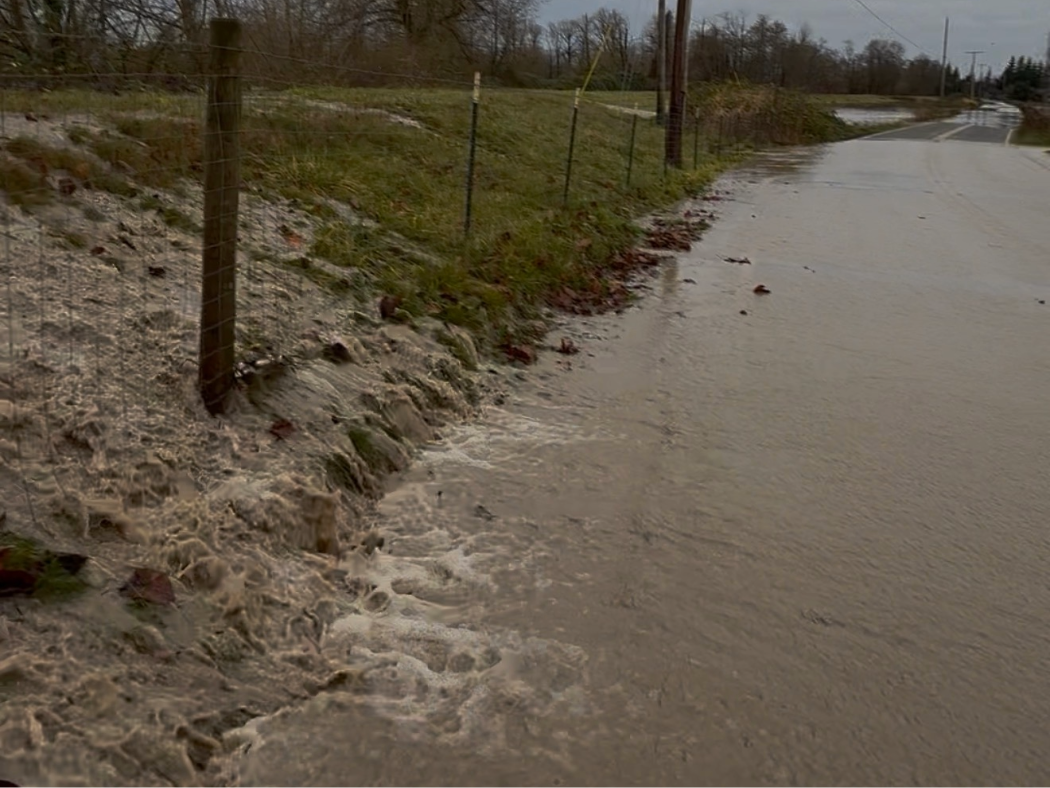
A levee along the Nooksack River reveals the river has breached its banks spilling into Lynden farmland. (PNW Daily staff)
BELLINGHAM, Wash. — Whatcom County flood officials will meet Tuesday evening to discuss major work planned along the Nooksack River and the county’s ability to deliver those projects.
The Flood Control Zone District Advisory Committee will meet at 7 p.m. July 21 in Bellingham. Members will receive updates on floodplain planning, the district budget and progress on a long-delayed federal home-elevation grant that was finally released this spring.
The brief agenda also lists a “strategy to increase capacity for major work ahead.”
County Prepares for Larger Flood Program
That discussion comes as Whatcom County prepares to move several flood-reduction concepts toward design and construction.
Many of those projects grew from the county’s Floodplain Integrated Planning process, known as FLIP. The county launched FLIP in 2017 to update its plan for managing floods along the Nooksack River.
The process brings together county staff, tribes, cities, farmers and diking districts. State and federal agencies also participate.
Through FLIP, those groups seek projects that reduce flood danger without shifting additional risk to another community. The process also considers salmon recovery, tribal resources and the future of floodplain agriculture.
However, the destructive November 2021 floods changed the county’s priorities. Much of the recent work has focused on the Everson Flow Split.
During major floods, water can leave the Nooksack River upstream from Everson. It then moves north toward Sumas, crosses into British Columbia and eventually reaches the Fraser River system.
Meanwhile, water that remains in the Nooksack continues downstream toward Lynden, Ferndale and Bellingham Bay. Any major change near Everson could affect communities in both directions.
Projects Could Cost Hundreds of Millions
County flood managers have outlined a large portfolio of potential projects.
The work includes possible flood-protection berms around Everson and Nooksack. Officials have also studied new channels in the Everson corridor, Ferndale levee improvements and targeted sediment management.
Other concepts would reconnect parts of the river with its floodplain. Those projects could provide the river with more room during major floods while improving fish habitat.
Earlier this year, county flood managers estimated that near-term projects could require approximately $182 million over five years. Long-term improvements could cost approximately $474 million.
As a result, the county must increase its ability to manage design, property agreements, environmental reviews and construction. Staff must also coordinate with tribes, cities, landowners and Canadian officials.
Tuesday’s agenda does not explain how the county plans to increase that capacity. However, options could include adding employees, expanding consultant contracts or creating new project-delivery partnerships.
Budget Could Shape Construction Timeline
The advisory committee will also receive an update on the Flood Control Zone District budget.
Property owners across Whatcom County fund the district through a dedicated property tax. The county uses that revenue for flood-control projects, maintenance and surface-water management.
Additionally, local revenue can help the county secure larger state and federal grants. Those programs often require matching funds and extensive preliminary work.
The Whatcom County Council serves as the district’s Board of Supervisors. The citizen advisory committee reviews flood issues and makes recommendations to the board.
Therefore, the budget update could show whether the district has enough money and staff to advance its growing project list.
Federal Grant Would Elevate 16 Homes
Committee members will also discuss FEMA Hazard Mitigation Grant Program project 4635-02.
Whatcom County applied for the grant after the November 2021 floods. It would help elevate 16 flood-prone homes in Sumas, Ferndale and unincorporated Whatcom County.
Home elevation raises the occupied portion of a house above the required flood level. The structure can then remain in place while reducing the risk of damage during future floods.
The county submitted the application in August 2022. FEMA and the Washington Emergency Management Division later approved it.
However, federal officials did not immediately release the money. The county said a new review requirement delayed grants worth more than $100,000 pending final authorization from the U.S. Department of Homeland Security.
In February, the Whatcom County Council asked state and federal officials to help secure the funding. Council members said families had already waited more than four years for help.
Federal officials cleared the funding in March, ending years of delay. Weeks later, on May 26, the Whatcom County Council voted 7-0 to accept a $4,156,725 state grant covering the elevation work. County records show most of the 16 properties sit in Deming, Sumas and Ferndale, with the remaining four located elsewhere in the county. The grant expires in April 2027.
The county hired Black & Veach to oversee compliance with the grant’s requirements, while the nonprofit Whatcom Long Term Recovery Group will help guide the 16 homeowners through the elevation process locally.
Tuesday’s update could detail how that work is progressing.
Meeting Open to the Public
The Flood Control Zone District Advisory Committee meeting will begin at 7 p.m. Tuesday, July 21 and is available via Zoom.
The county will hold the hybrid meeting in the Garden Level Conference Room at the Civic Center Annex, 322 N. Commercial St. in Bellingham. People may also attend through Zoom.
The meeting notice lists a scheduled end time of 8:30 p.m.
Frequently Asked Questions
About the Author