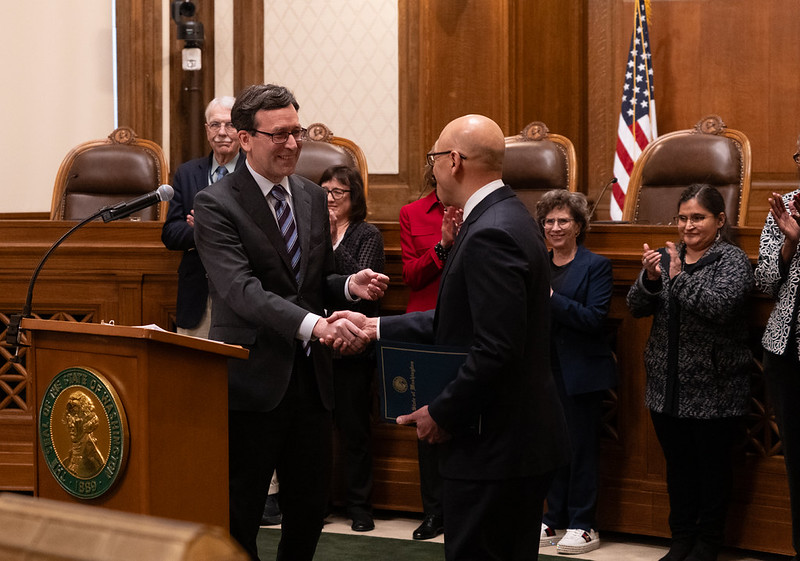
Governor Ferguson appointed Theo Angelis to the Washington State Supreme Court in March. (Gov. Ferguson's Office)
SKAGIT COUNTY, Wash. — Skagit County is preparing to expand its Superior Court bench for the first time in years as state and local leaders move forward with adding a fifth judge to handle a growing caseload.
The Washington State Legislature approved the new position under SB 5868, formally increasing the number of judges in Skagit County Superior Court from four to five. While lawmakers authorized the seat, the position only became reality after Skagit County approved funding its share locally, clearing the way for the appointment process to begin.
Because this is a newly created seat, the first judge will be appointed by the governor rather than elected.
That gives Bob Ferguson significant influence over the future of the local court. The selection process typically relies on bar association evaluations, recommendations from within the legal community, and review of each applicant’s professional background.
Why This Position Is Opening Now
The new judgeship is part of a broader effort across Washington to address increasing pressure on the court system.
Skagit County, like many mid-sized counties, has seen steady population growth alongside more complex criminal, civil, and family law cases. Court systems are still working through delays that built up during the pandemic, contributing to longer timelines and heavier workloads for existing judges.
Despite those challenges, adding judges is not automatic.
The Legislature can authorize new positions, and the state typically covers a portion of judicial salaries through the operating budget. However, counties are responsible for significant local costs, including facilities, staffing, and part of judicial compensation.
That shared funding model often delays expansion, even in areas that qualify for additional judicial resources.
A Quiet Search For Now
At this stage, no candidates have been publicly identified.
Judicial appointments often develop behind the scenes, with potential applicants weighing the transition from private practice or other legal roles into a position that comes with a different workload, public visibility, and pay structure.
That creates an additional challenge: a limited pipeline of attorneys willing to step into judicial roles, particularly in smaller counties.
What Happens Next
The application window will remain open through early August, with judicial evaluations and recommendations expected to follow.
From there, a shortlist of candidates typically begins to take shape before the governor makes a final appointment.
For now, the addition of a fifth judge signals a shift for Skagit County’s court system, one aimed at reducing backlogs and improving how quickly cases move through the courts.
In Washington, judicial appointments are driven primarily by when vacancies occur rather than any change in executive capacity or pace. This means that apparent differences between governors are largely a function of timing rather than volume.
A Decision That Could Last Years
Supporters of the current system note that Washington’s judiciary remains independently elected at the end of appointed terms, and that gubernatorial appointments are limited to filling vacancies as they occur under state law.
Republican lawmaker State Rep. Hunter Abell said before the last appointment he was concerned a growing number of judges leaving the bench before their terms expire has also increased the opportunity for Ferguson appointments without direct voter input.
When you’ve got a majority of the Supreme Court and almost 80 percent of the Court of Appeals appointed by the governor with no input from the Legislature, then it starts to look like the Supreme Court and the Court of Appeals are wholly owned subsidiaries of the governor’s mansion.
— State Rep. Hunter Abell
Ferguson’s Early Judicial Appointment Context
Since taking office in January 2025, Gov. Bob Ferguson has already made several high‑profile judicial appointments at multiple levels of Washington’s court system.
That activity reflects one of the governor’s constitutionally defined leadership roles: filling judicial vacancies with qualified candidates who will serve until the next election.
In recent months, Ferguson has appointed:
- Colleen Melody to the Washington Supreme Court, replacing a retiring justice — a move that took place in late 2025.
- Theodore (Theo) J. Angelis to the Washington Supreme Court, announced in March 2026 to fill another vacancy.
Both appointments illustrate the governor’s role in shaping the state’s highest judicial body at a moment when several justices have retired — a rare occurrence that opens considerable room for new influence on the court’s composition.
“Theo’s impressive qualifications and accomplishments speak for themselves,” Ferguson said. “His colleagues praise his legal expertise, humility and integrity. Even opposing counsel who faced him in court describe Theo as ‘the smartest lawyer I’ve ever faced,’ and a decent, honorable person. He will serve the people of Washington well on our highest court.”
About the Author