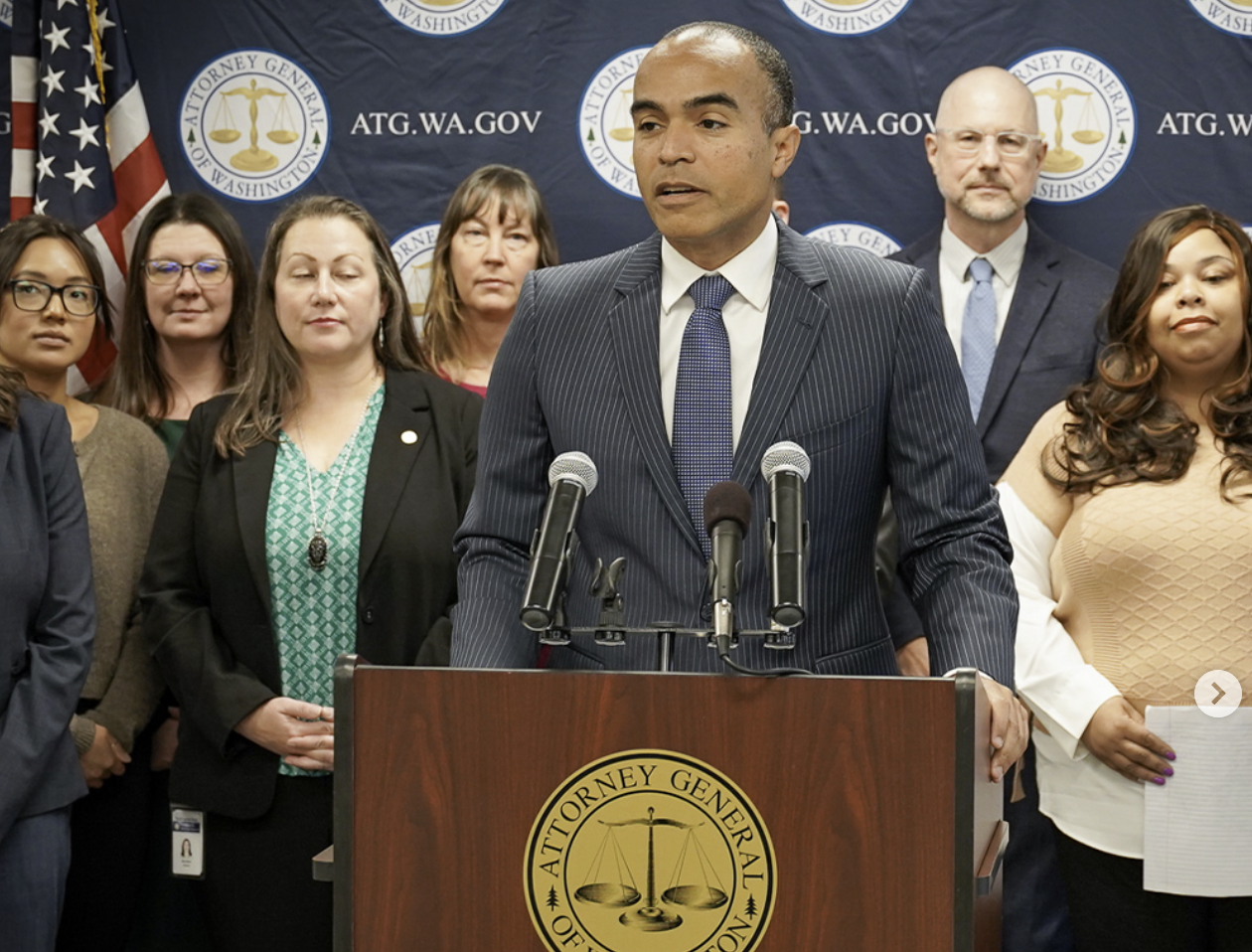
Washington Attorney General Nick Brown. (Photo: WA AG Office)
OLYMPIA, Wash. — Washington Attorney General Nick Brown is co-leading a coalition of 21 attorneys general challenging the U.S. Department of Agriculture’s reorganization plan, arguing the changes could weaken wildfire response, disrupt food assistance programs and threaten agricultural research.
“Washington has worked extensively with the National Forest Service this year to help deal with the wildfires that have devastated parts of our state. Under the administration’s plan, the Forest Service and other important parts of USDA would be hollowed out, making Washington more vulnerable to future fires.”
Nick Brown, Washington Attorney General
The coalition filed an amicus brief Wednesday, Sept. 16, in federal court in Northern California. The states are supporting a lawsuit brought by federal employee unions and other plaintiffs seeking to block the USDA reorganization.
A federal judge has temporarily paused much of the reorganization and associated employee relocations while the case moves forward. U.S. District Judge Vince Chhabria issued an administrative stay through Oct. 2 and scheduled a hearing on the plaintiffs’ request for a preliminary injunction for Sept. 29. The stay prevents USDA from enforcing certain deadlines requiring employees to report to new locations or accept or decline reassignment.
The states’ brief focuses on how USDA’s restructuring could affect programs that depend on cooperation between federal agencies and state governments.
Washington cites wildfire response concerns
Washington’s Forest Service partnership is a central concern in the states’ filing.
The brief says the Forest Service owns about 22% of Washington’s land. Federal, state, tribal and local agencies also work together on wildfire prevention and response because fires cross jurisdictional boundaries.
According to the filing, the Forest Service lost nearly 6,000 employees in 2025, or about 16% of its workforce. The states say the loss has already contributed to smaller firefighting crews, fewer experienced leaders and gaps in logistics and coordination during the 2026 fire season.
The coalition says the proposed reorganization could add to those staffing losses by requiring some employees to relocate or leave the agency.
The filing specifically points to employees involved in incident management teams and other specialized positions that coordinate large and complex wildfire responses.
The states argue that replacing those workers would take time because new employees would need training and experience before taking on specialized wildfire responsibilities. The filing says that could affect both the remainder of the 2026 fire season and preparations for 2027.
States depend on USDA food assistance programs
Washington also relies on USDA personnel to administer federal food and nutrition programs.
The Washington Attorney General’s Office says the state’s Department of Social and Health Services depends on USDA Food and Nutrition Administration personnel for program guidance, funding, oversight, technical assistance and coordination.
Those federal-state partnerships include the Supplemental Nutrition Assistance Program, or SNAP, along with the Special Supplemental Nutrition Program for Women, Infants and Children, known as WIC.
The coalition’s brief says states handle much of the day-to-day administration and distribution of benefits while relying on USDA personnel for technical support and program guidance.
The states argue that staffing losses at the federal agency could make it more difficult for state agencies to receive timely answers, obtain program waivers and implement changes.
The brief says the Food and Nutrition Administration had already lost 35% of its staff before the latest reorganization plan. It also says five of the agency’s seven regional offices are slated for closure, with employees being reassigned to new USDA hub cities.
Agricultural research is another concern
The coalition also argues that USDA’s research restructuring could affect food safety and agricultural research.
One example involves the Beltsville Agricultural Research Center in Maryland, which houses Agricultural Research Service programs. The states’ brief says the center has supported agricultural and food-safety research for more than a century.
Researchers at the center have worked on subjects ranging from honeybee health to foodborne disease.
The filing specifically points to ongoing research into cyclospora, a foodborne parasite that can cause severe illness. The coalition says researchers working on at least one cyclospora project at Beltsville have declined to relocate, raising concerns about the loss of specialized knowledge, equipment and research samples.
The filing connects those concerns to the current cyclospora outbreak, which the states describe as the largest recorded U.S. outbreak.
The states also cite a previous USDA relocation involving the Economic Research Service and National Institute of Food and Agriculture. According to the brief, a Government Accountability Office review found that the earlier relocation resulted in significant employee losses and declines in productivity and constituent services.
Court challenge continues
The 21-state coalition is asking the federal court to grant the plaintiffs’ request for a preliminary injunction blocking the USDA reorganization.
The lawsuit was filed in the U.S. District Court for the Northern District of California. The states’ filing argues that the reorganization could harm state agencies that rely on USDA programs and federal expertise.
The court’s temporary stay does not decide whether the reorganization is lawful. Judge Chhabria said the administrative stay was intended to give the court additional time to consider the issues while the preliminary-injunction request proceeds.
The Sept. 29 hearing is expected to address whether the court should extend the pause while the broader legal challenge continues.
The coalition supporting the brief includes the attorneys general of Washington, California, Maryland, Arizona, Connecticut, Delaware, Hawai’i, Illinois, Maine, Massachusetts, Michigan, Minnesota, Nevada, New Jersey, New Mexico, New York, Oregon, Rhode Island, Vermont, Virginia and the District of Columbia.
Frequently Asked Questions
About the Author