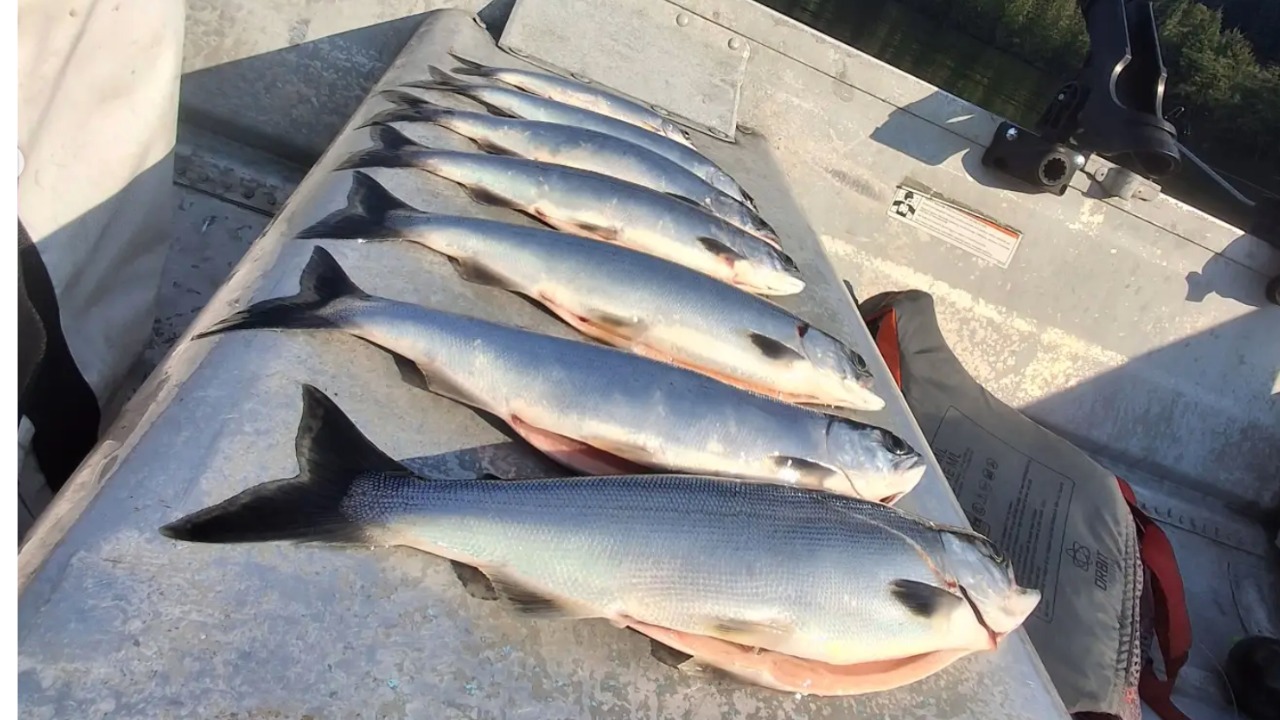
Chris Hamilton of Yeager’s Sporting Goods shows off his catch of Lake Samish kokanee caught Tuesday morning. (Photo courtesy of Chris Hamilton)
OUTDOOR
REPORT
BELLINGHAM, Wash. — King salmon fishing will return to most of Marine Area 7 for two additional days as anglers begin the final countdown to several Aug. 1 salmon openings across northwest Washington.
The Washington Department of Fish and Wildlife announced this week that Marine Area 7, covering the San Juan Islands, will reopen for hatchery Chinook on Sunday and Monday, July 26-27. Bellingham Bay remains excluded from the two-day opening.
“Additional Chinook fishing days for Marine Area 7 may occur in August, pending catch estimate updates.”
— WDFW
Chinook Quota Leaves Room for Two More Days
Anglers harvested an estimated 1,403 hatchery Chinook through July 18. That represents 64% of the area’s 2,181-fish harvest quota.
Meanwhile, anglers encountered an estimated 877 unmarked Chinook, reaching 24% of the 3,672-fish limit. They also encountered 292 undersized Chinook, or 12% of the 2,429-fish limit.
Chinook must measure at least 22 inches to be retained.
The relatively low encounter rates gave fishery managers enough room to offer another Sunday and Monday on the water. However, anglers should check WDFW emergency regulations before leaving because the department may adjust seasons as new catch estimates arrive.
Bellingham Bay will open for salmon fishing seven days per week from Aug. 1 through Sept. 30. The rest of Marine Area 7 opens for hatchery coho fishing seven days per week throughout August.
Nonselective coho fishing begins Sept. 1 and continues through Sept. 30. Hale Passage does not open for salmon until Sept. 1.
This Outdoor Report is sponsored by Yeager’s Sporting Goods, located at 3101 Northwest Avenue in Bellingham.

Baker Sockeye Run Tracking Far Below Forecast
The Baker River sockeye return has fallen far short of its preseason forecast, while fishing in Baker Lake remains extremely slow as finding sizeable schools of sockeye has been difficult.
Guides have resorted to using bass tactics such as front facing sonar, to great success, but for those used to being able to troll the old lake bed at 20-50 feet and still being able to catch fish without electronics it has been a grind.
WDFW counted 20,560 sockeye through July 22. That represents just 29% of the preseason forecast of 70,861 fish.
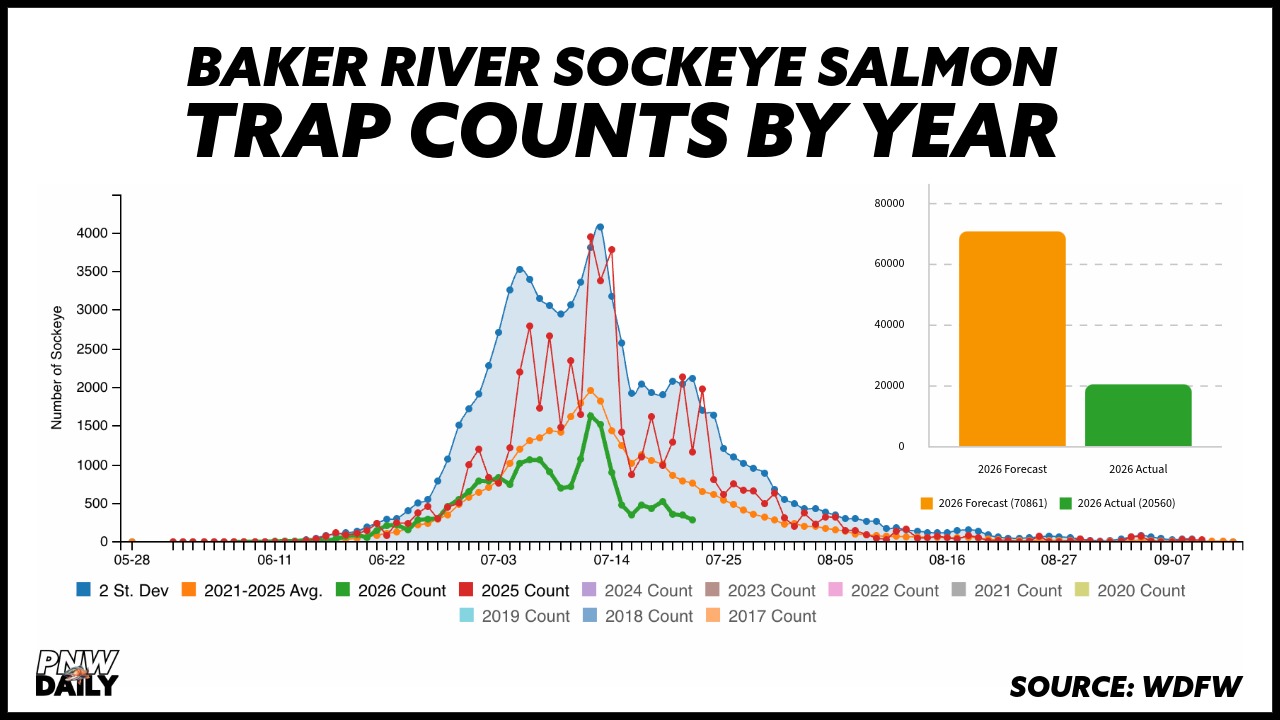
The total includes 11,547 sockeye transferred to Baker Lake, 3,157 moved to the spawning beach and 5,846 retained for broodstock. Ten fish died at the trap.
Daily counts peaked at 1,631 fish on July 12. Since then, the run has declined sharply. Counts dropped from 896 fish on July 14 to 286 on July 22.
During the most recent seven complete days, WDFW counted 2,767 sockeye, an average of 395 per day. However, that average remains inflated by stronger counts earlier in the period.
A projection based on the current rate of decline puts the cumulative count near 22,800 to 23,000 fish by July 31. Even if the latest seven-day average held steady, the count would only reach about 24,100.
Therefore, the most reasonable end-of-July projection sits between 23,000 and 24,000 sockeye. That would equal roughly one-third of the preseason forecast.
Some fish will continue arriving in August. Still, the current trajectory makes reaching the 70,861-fish forecast extremely unlikely.
Fishing has reflected the lower return. Anglers continue to report tough conditions at Baker Lake, although lighter traffic at the launches has made getting on and off the water easier this week.
Lake Samish Kokanee Offer an Alternative
Lake Samish has become an alternative for anglers tired of driving to Baker Lake and struggling for sockeye.
Anglers continue to catch kokanee, although warming summer water has pushed many fish into deeper offshore areas near the thermocline. Trolling anglers may need to use their electronics and experiment with depth until they locate schools.
The kokanee season typically remains productive through summer. Adult fish begin moving toward tributaries in late October and early November.
Lake Samish sits about 6.5 miles southeast of Bellingham. WDFW maintains an access area with a boat launch and toilet on the east side of the lake. Two-pole fishing is allowed with the proper endorsement.
The lake also supports coastal cutthroat trout, largemouth bass, smallmouth bass and yellow perch.
This Outdoor Report is sponsored by Yeager’s Sporting Goods, located at 3101 Northwest Avenue in Bellingham.
Whatcom County Bass Fishing Stays Hot
Bass fishing remains one of the most consistent freshwater opportunities in Whatcom County.
Anglers have reported strong action at Lake Whatcom, Wiser Lake and Lake Terrell. Warm water has increased bass activity, particularly around vegetation, docks, shade and other shoreline cover.
Early mornings and evenings can provide more comfortable conditions for anglers. However, deeper structure may produce during the middle of the day as fish move away from bright sunlight and warmer surface water.
With Baker Lake struggling and the next round of salmon opportunities approaching, local bass and kokanee fisheries provide solid options for the final week of July.
The broader fishing calendar changes again Aug. 1, when Bellingham Bay and several coho fisheries open. Anglers should review current WDFW regulations and emergency rules before fishing because salmon seasons can change quickly.
The PNW Daily Outdoor Report is sponsored by Yeager’s Sporting Goods in Bellingham.
Frequently Asked Questions
PNW Daily brings you The Outdoor Report as part of the ongoing series sponsored by Yeager’s Sporting Goods.

About the Author