

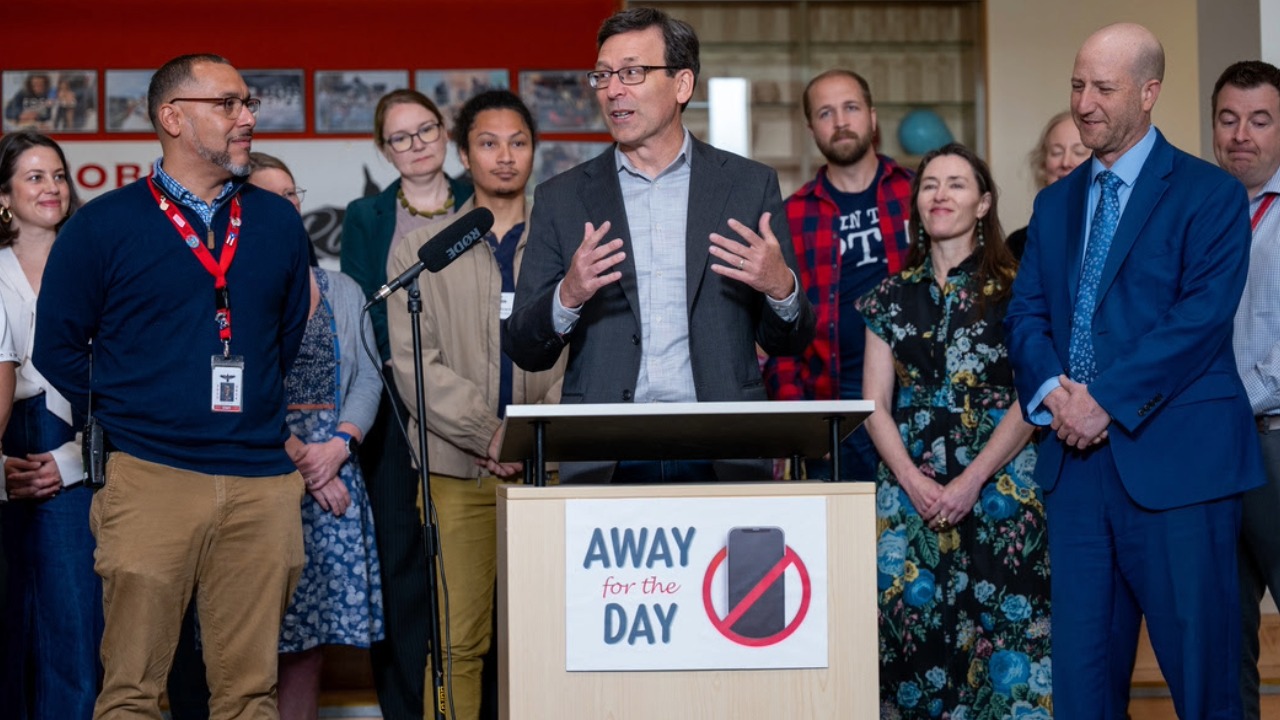
Washington could adopt a statewide bell-to-bell cellphone ban by 2027. But critics say the report card behind the push ignores student outcomes, classroom technology and reforms that boosted achievement elsewhere. (Photo: Gov. Bob Ferguson)
OLYMPIA — Gov. Bob Ferguson announced Tuesday that banning student cellphones in Washington public schools will be among his top legislative priorities heading into the 2027 session, proposing a bell-to-bell prohibition on personal smart devices that he says will improve student focus and social engagement. The announcement drew immediate scrutiny over the evidence behind it.
Ferguson’s proposed “Away for the Day” policy would prohibit students in grades K-12 from using smartphones, smart watches and other personal smart devices from the first bell to the last bell.
“Our kids are missing what’s written on the whiteboard and focusing more on memes instead of math because of digital distractions,” Ferguson said during Tuesday’s announcement in Seattle.
Ferguson said his office will spend the next three months gathering input from students, educators and parents before releasing a detailed proposal Sept. 15. He expects to prefile legislation when bill filing opens Dec. 7. If approved, the policy would take effect for the 2027-28 school year.
The “F” Grade That Isn’t What It Sounds Like
Central to the governor’s case was a national report card that gave Washington an “F” for its cellphone policies. Ferguson presented the grade as evidence that the state has fallen behind. What he did not mention is how the grade is calculated.
The report card is produced by Phone-Free Schools, an organization that advocates for strict bell-to-bell device bans. Its grading methodology assigns a flat failing score of 50 points to any state whose cellphone legislation failed during the prior session. The grade is given regardless of what policies are already in place at the district level and ignores evidence-based student outcomes.
A state with no legislation at all receives a zero. Washington’s F reflects a 2025 bill that did not pass, not an assessment of student outcomes, classroom performance or existing district-level policies.
According to the Office of the Superintendent of Public Instruction, approximately 75 percent of Washington school districts already have policies limiting cellphone use in classrooms. The advocacy scorecard does not account for that.
What the Research Actually Shows
Ferguson’s proposal rests on the assumption that personal smartphones are a primary driver of poor academic performance. The research on that question is more complicated than the press release suggests.
Studies cited by Ferguson’s office show that students spend a significant portion of the school day on personal devices, and that one-third of teachers nationally identify cellphone distraction as a major problem. Those findings are real. But a large 2026 study found that while school phone bans significantly reduced phone use, they produced little measurable effect on test scores, attendance or several other key academic indicators.
At the same time, a growing body of research raises questions about school-issued technology. Multiple analyses by the Organisation for Economic Co-operation and Development found that students who use digital devices most heavily at school often perform worse academically than peers with more moderate use.
Ferguson’s proposal addresses personal phones. It does not address Chromebooks, tablets, AI tools or other school-issued screens that Washington students use throughout the school day under state-funded one-to-one device programs.
Mississippi Is Doing Something Different
While Washington pursues a device ban, education researchers have been focused this year on a different set of reforms entirely.
The 2026 Education Scorecard, a collaboration between Harvard and Stanford researchers, found that Mississippi is among only seven states that improved in reading achievement in the three years following the COVID pandemic. Mississippi climbed from 49th to 9th in fourth-grade reading on the National Assessment of Educational Progress since 2013 — a period during which the state pursued structured literacy reforms, third-grade retention policies, teacher coaching and curriculum accountability measures, not device restrictions.
The scorecard found that every state which improved reading scores between 2022 and 2025 was implementing comprehensive science-of-reading reforms. Washington is not on that list.
Ferguson’s announcement did not address Washington’s standing on reading or math proficiency, or whether the state plans to pursue the kind of curriculum and instruction reforms that have produced measurable gains elsewhere.
Student Phones Have Also Become Accountability Tools
Critics of cellphone bans argue that student phones serve a purpose beyond communication and social media. In Washington and across the country, student-recorded videos have documented bullying, hazing, fights and alleged misconduct that later became the subject of investigations, disciplinary actions and lawsuits.
One of the most notable Washington examples occurred in 2024, when student cellphone footage helped expose alleged hazing involving members of the Mead High School football program. The recordings became central to a police investigation and a subsequent lawsuit filed against the school district by parents.
Supporters of cellphone restrictions argue that schools already have reporting systems, security cameras and administrative procedures for addressing misconduct. Critics counter that many high-profile incidents only came to light because students documented them in real time.
The issue surfaced Tuesday when Pierce County Sheriff Keith Swank criticized Ferguson’s proposal on X.
“If you don’t want kids to have phones in school, it must be to hide the illegal activities of the teachers,” Swank wrote.
Swank did not elaborate on the statement. However, his comments reflect a broader concern among some parents who view student cellphones as an accountability tool that can preserve evidence when misconduct occurs.
Ferguson’s announcement did not address how incidents currently documented by students would be handled under a statewide bell-to-bell cellphone ban. The governor’s office said details regarding enforcement, exceptions and emergency communication plans will be developed during a statewide stakeholder process this summer.
What Comes Next
Ferguson said he will hold listening sessions across Washington over the summer before unveiling a final proposal in September. Topics under discussion will include enforcement mechanisms, district support needs, the scope of medical and IEP exceptions, and emergency communication plans.
Washington would join at least 31 states and the District of Columbia that already restrict student cellphone use in schools, according to Education Week. Of those states, 22 have bell-to-bell bans in place.
The governor expects to prefile the request bill Dec. 7 and move it through the 2027 legislative session for a September 2027 implementation date.
Frequently Asked Questions
About the Author





1 thought on “Gov. Ferguson Pushes Washington School Cellphone Ban”