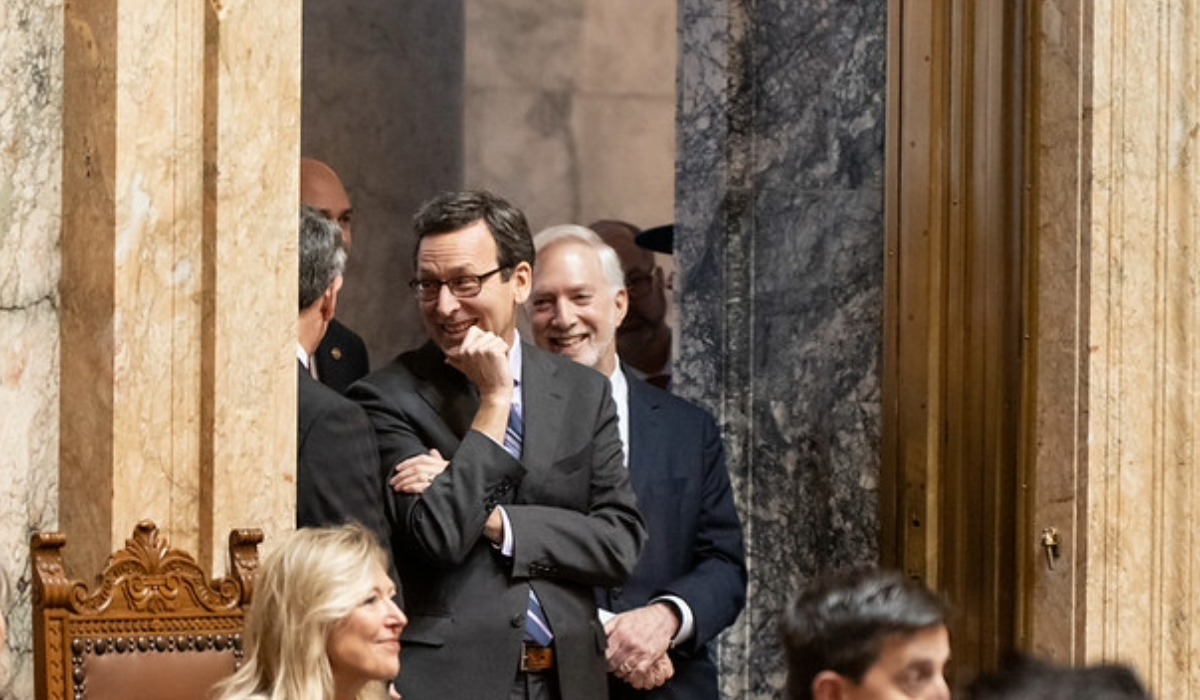
Washington Gov. Bob Ferguson stands outside the House chamber before laying out his legislative agenda the State of the State address in Olympia in January. SB 5974, a bill affecting sheriff certification and eligibility for office, now heads to the governor’s desk. (WA Gov's Office)
OLYMPIA, Wash. — Washington lawmakers passed the SB 5974 sheriff bill during the final days of the legislative session, sending the controversial measure to the governor after hours of debate over local control and law enforcement oversight.
While most of Washington was asleep at 1:20 a.m. and after nearly 8 hours of debate, House Democrats passed a bill that would allow an unelected state board of appointees to remove a sheriff from office.
The SB 5974 sheriff bill requires sheriffs across Washington to maintain certification through the state Criminal Justice Training Commission. If a sheriff loses certification, state law would declare the office vacant.
Supporters say the bill strengthens accountability for law enforcement leaders. Critics, however, argue the proposal shifts power away from voters who elect county sheriffs.
Whatcom County Sheriff Donnell Tanksley said the proposal reduces local control over the position.
“It has been stated that this bill intends to elevate standards and reflect best practices for law enforcement leaders,” Tanksley said. “However, criteria and standards for the office of the sheriff and best practices are already in place.”
Lawmakers approved the measure largely along party lines.
What the bill would change
The SB 5974 sheriff bill creates new eligibility requirements for sheriff candidates across Washington.
First, candidates must meet statewide standards before running for the office. In addition, newly elected sheriffs must obtain certification through the Criminal Justice Training Commission within nine months.
If a sheriff fails to obtain certification or later loses it, state law would declare the position vacant.
The legislation also adds new oversight for reserve deputies and volunteer sheriff posses. Those programs often support rural sheriff departments with limited staffing.
Supporters say the changes ensure law enforcement leaders meet the same professional standards required of sworn officers.
Sheriffs warn of reduced voter control
However, several Washington sheriffs strongly opposed the bill during legislative hearings.
Critics say the legislation shifts authority away from county voters. Instead, they argue a state regulatory body could effectively determine whether an elected sheriff remains in office.
Opponents also note that voters already have mechanisms to hold sheriffs accountable through elections, recalls and criminal charges.
Meanwhile, Pierce County Sheriff Keith Swank has emerged as one of the bill’s most vocal critics.
“Democrats are going to try to remove me from office not because of malfeasance, but for speech,” Swank said Friday. “Let that sink in. I haven’t done ANYTHING wrong except speak out against them.”
Swank argues lawmakers designed the proposal with him in mind because he has publicly challenged state leaders on several law enforcement policies.
According to Swank, the bill could allow a state regulatory board to remove a sheriff elected by voters if certification is revoked.
“Washington voters elect sheriffs and set tax limits at the ballot box. Period,” Swank said. “The Democrat super majority in Olympia is ramming through bills that rip power from the people and hand it to unelected insiders.”
Bill sponsored by former sheriff
State Sen. John Lovick introduced the SB 5974 sheriff bill.
Lovick represents Mill Creek and previously served as Snohomish County sheriff. He also spent decades working in law enforcement before entering the Legislature.
Lovick argues the proposal simply requires sheriffs to meet the same professional standards as the officers they supervise.
Supporters of the legislation say the bill applies equally to every sheriff in the state.
Debate highlights state and local tension
The debate surrounding the SB 5974 sheriff bill reflects a broader conflict over the role of locally elected sheriffs.
Sheriffs serve as constitutional county officers who voters elect directly. Because of that structure, critics say linking the office to state certification creates a new pathway for removal outside the ballot box.
Supporters disagree. Instead, they argue the certification requirement protects the integrity of law enforcement leadership.
If the governor signs the measure into law, the changes will apply statewide.
About the Author