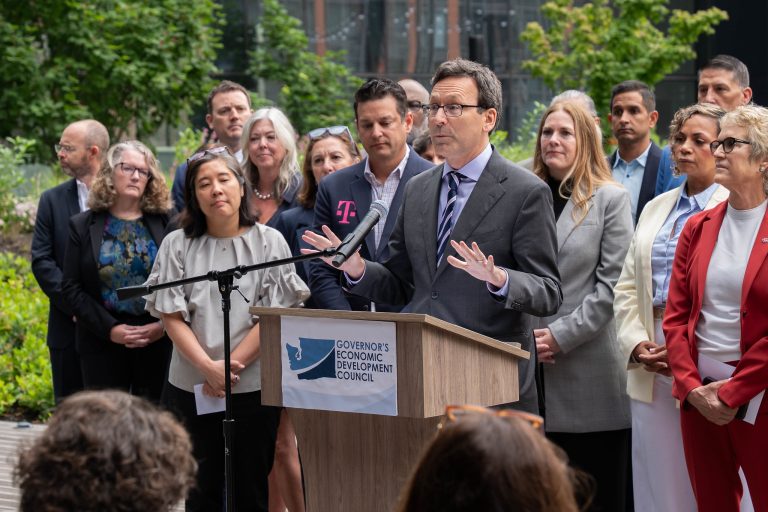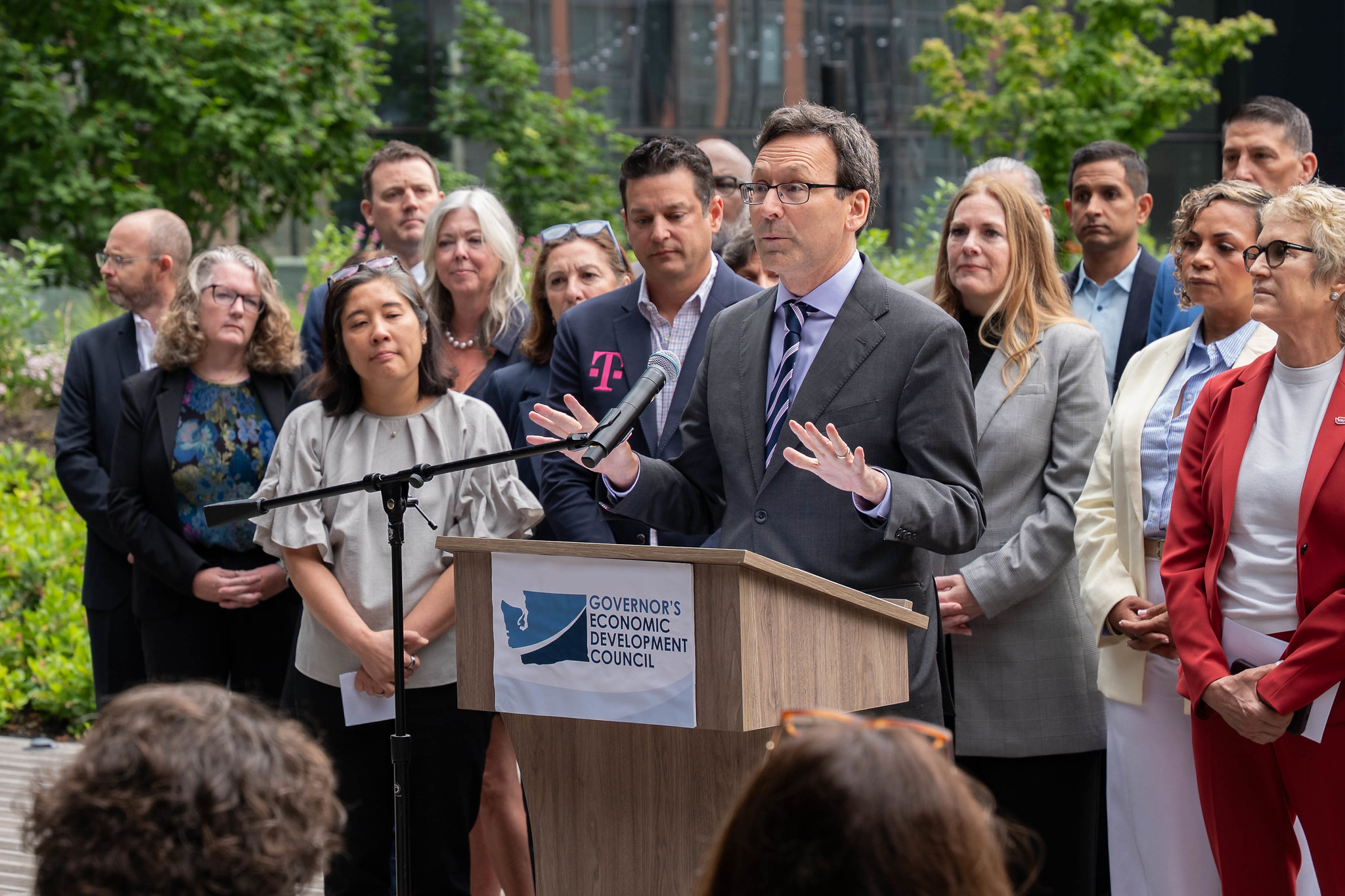
Gov. Bob Ferguson announced in July a new Governor’s Economic Development Council, bringing together small businesses, labor, tribes, educators and large tech and aerospace employers to help guide the state’s economic strategy. (Photo: Washington State Governor's Office)
OLYMPIA, Wash. — The cost of building a home can rise long before construction begins. Land availability, infrastructure, local planning requirements and financing all affect whether a housing project moves forward, according to a preliminary report the Washington State Department of Commerce released Tuesday.
The department delivered its first report as a part of a housing accelerator project proposed by Governor Bob Ferguson called the Washington Accelerator for Residential Production, or WARP.
“When I was running for Governor, I visited all 39 counties, and by far, the issue I heard about the most was housing. That’s why it’s been one of my top priorities since day one of my administration. We’ve made historic investments in building more housing and making housing more affordable.”
— Gov. Bob Ferguson
The report to examines barriers to homeownership and rental housing, identifies major cost drivers for single-family, multifamily and middle housing, and looks to find opportunities to shorten development timelines.
“This report is the next step in building a framework for efficient, effective regulation that lets us build more housing of all kinds,” Ferguson said.
Commerce must submit its final report to the governor and Legislature by June 30, 2027.
Report Identifies Barriers Throughout Development Process
The preliminary report divides housing development into six stages: planning, infrastructure and land availability, project design and permitting, financing, construction, and sales or rental.
At the planning stage, lengthy updates to local regulations can slow development. Existing zoning also may not accommodate the types of housing communities need. The report identifies funding for comprehensive plan implementation and technical assistance as potential ways to address those issues.
Infrastructure and land availability create another set of challenges. Projects can stall when suitable land lacks utilities or when developers cannot secure infrastructure improvements on a workable timeline. The report lists utility extension funding, phased infrastructure improvements, assistance with land acquisition and land banking as options for further consideration.
During project design and permitting, differences among local regulations can add uncertainty and delay. More standardized zoning, streamlined local permitting and incentives for jurisdictions to develop permit-ready plans.
Financing presents obstacles for smaller developers and projects involving newer housing types. The report identifies high interest rates, limited financing options and inconsistent affordable housing funding as issues. Potential responses include a loan guarantee fund, more predictable funding for the state Housing Trust Fund, greater flexibility for lenders and better coordination among public funding programs.
Construction costs also warrant further examination. The report points to supply-chain and material expenses, along with labor costs. Options include changes to sales tax policies, more flexibility in meeting building and energy code requirements, workforce development and expanded use of modular or offsite construction.
The final stage covers the sale and rental of completed housing. Homeowners association rules can restrict additional development, while some ownership models remain unfamiliar or difficult to use. The report identifies technical assistance for condominium, unit-lot subdivision and permanently affordable ownership models, along with incentives for moderate-income homeownership.
Commerce Will Seek Input Before Final Recommendations
Commerce worked with BERK Consulting to develop the preliminary framework.
“When homes cost too much and take too long to build, families pay for it in higher rents, longer commutes and fewer chances to own a home. WARP is how we get on the same page about what is slowing down building so we can work together to remove barriers to creating more housing.”
— Sarah Clifthorne, Commerce Interim Director
The department reviewed more than 20 studies and reports from the past decade, considered recommendations from earlier housing efforts and examined responses from state agencies to Executive Order 25-02.
That order, issued by Gov. Bob Ferguson in 2025, directed state agencies to review rules and regulations affecting new housing and identify opportunities to remove unnecessary barriers and streamline requirements. The review also had to consider environmental and cultural impacts.
Commerce’s work also draws on input from the Housing Department Task Force, created under Executive Order 25-12 to consider the potential creation of a cabinet-level state Department of Housing.
The next phase includes consultation with local governments and a broad range of housing-related groups. Those groups include nonprofit and for-profit developers, builders and construction trades, real estate agents, landlords, tenants, mortgage lenders, utility providers, public housing authorities, architects and statewide business organizations.
Commerce has scheduled additional meetings on regulations and permitting for Dec. 3, innovative housing types for Jan. 6, financing, insurance, real estate and taxes for Jan. 27, and construction costs for Feb. 10.
The department plans to use those discussions and additional research to identify its leading recommendations, assess their legal and practical implications, and consider potential pilot programs.
Housing Growth Remains Concentrated
The report also places the work against recent housing production figures. Washington added approximately 41,000 housing units between April 2025 and March 2026, according to the state Office of Financial Management.
Multifamily housing accounted for 62% of that growth. Five counties: Clark, King, Pierce, Snohomish and Spokane, accounted for 69% of the new multifamily units.
Those figures show both the scale of recent construction and its geographic concentration. The report’s statewide framework will examine how policy, infrastructure and development costs affect housing production across different communities and housing types.
Commerce’s preliminary report does not determine which proposed changes the state will pursue. That work remains part of the consultation and research process, with the final framework due June 30, 2027.
Frequently Asked Questions
About the Author