

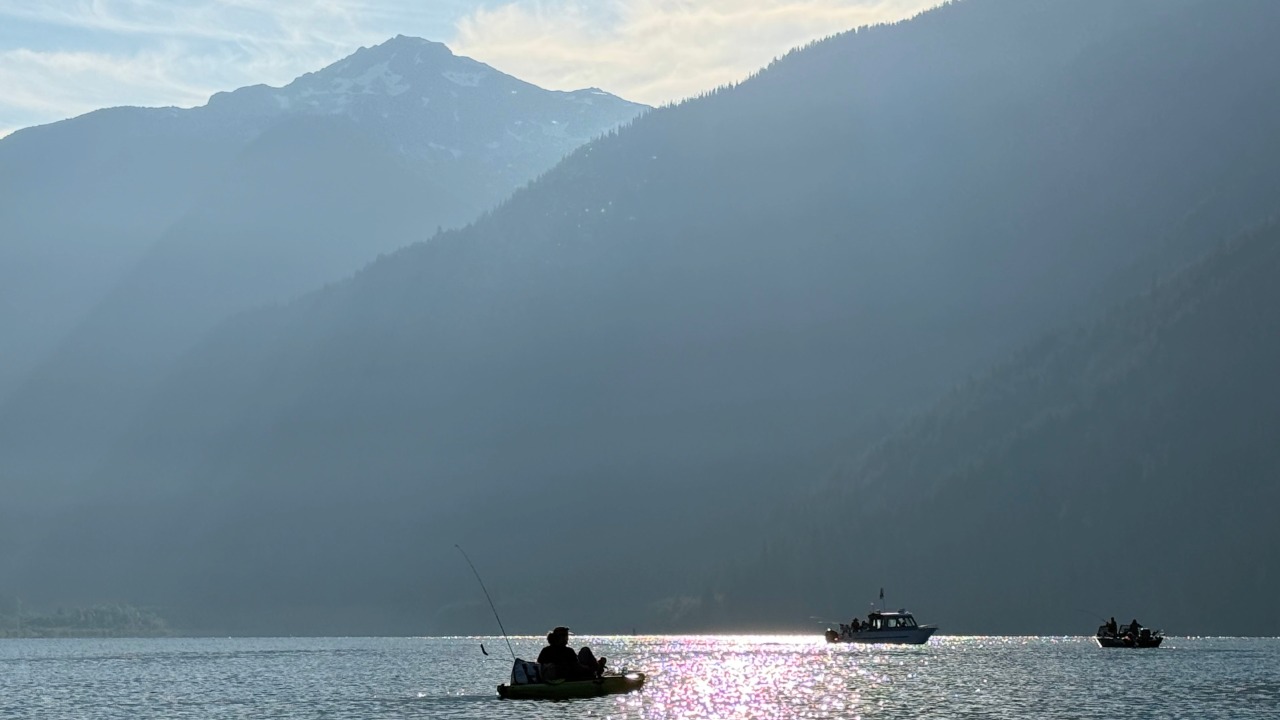
Chris Hamilton from Yeager's Sporting Goods in Bellingham is seen sockeye fishing in the smoky Baker Lake air on Tuesday morning. (Photo: PNW Daily)
WHATCOM COUNTY, Wash. — Visitors heading into the North Cascades on Tuesday found more than blue skies and mountain views.
A noticeable layer of haze stretched across Baker Lake as smoke from active wildfires burning in eastern Washington drifted west into the Cascades. While air quality remained generally good across much of northwest Washington, the smoke served as an early reminder that wildfire season is accelerating across the state.
Officials say smoke conditions can change quickly depending on wind direction and fire activity.
“Exposure to wildfire smoke can lead to a range of health issues, particularly for sensitive groups such as children, the elderly, and individuals with pre-existing respiratory or cardiovascular conditions.”
Washington State Fire Marshal’s Office
Whatcom County Fire Remains Active
Although much of the smoke affecting northwest Washington is drifting in from larger fires elsewhere in the state, firefighters continue monitoring the Luna Fire in remote North Cascades National Park.
The wildfire is burning about 2.8 miles southwest of Mount Prophet in northeastern Whatcom County. Watch Duty lists the fire at 22.3 acres. The incident remains active, although recent updates indicate little fire growth because of its isolated wilderness location.
Two additional local fires remain listed on Watch Duty. The Colony Mountain Fire west of Bellingham is approximately 0.25 acres, while the Shark Reef Fire in the San Juan Islands is listed at 0.1 acres. Neither fire is large enough to contribute significantly to the regional smoke.
Eastern Washington Fire Producing Most Smoke
The largest active wildfire currently burning in Washington is the B and O Fire in Okanogan County.
The human-caused fire, located about one mile southwest of Okanogan, has burned approximately 2,927 acres and was 19% contained as of Tuesday.
The fire is burning through dry grasses, brush and timber. State fire mobilization remains in effect, while residents south of Vicksmith Road continue under Level 1 “Be Ready” evacuation notices.
Although firefighters reported fire behavior has moderated, crews continue strengthening containment lines and extinguishing hot spots.
Olympic National Park Fire Remains Active
Firefighters are also working the Mt. Tom Creek Fire on a steep mountainside west of the Hoh Rainforest inside Olympic National Park.
The lightning-caused fire has burned 86 acres and reached 27% containment. Officials said dense forest canopy has prevented recent rainfall from reaching the fire, allowing smoldering to continue beneath the trees.
No homes, visitor centers or other developed areas are currently threatened.
Major Fires Now Fully Contained
Two of Washington’s largest recent wildfires have now been fully contained.
The Chelan Hills Fire, which ignited July 4, burned nearly 9,900 acres, destroyed more than 100 structures and claimed one life before firefighters achieved full containment. Crews remain on scene completing mop-up operations.
The Quincy Lakes Fire near Ancient Lakes has also reached 100% containment after burning 289 acres. Emergency managers have reduced evacuation levels as crews monitor for remaining hot spots.
Whatcom County Residents Should Be Ready
The Whatcom County Health and Community Services Department says wildfire smoke from British Columbia and eastern Washington frequently reaches northwest Washington during the summer, especially communities farther inland and away from the cooling influence of marine air.
Officials encourage residents to monitor conditions using Fire.AirNow.gov and create a household smoke plan before unhealthy air arrives.
The department also recommends using portable HEPA air purifiers or building inexpensive do-it-yourself box fan filters to improve indoor air quality during smoky conditions.
Sensitive Groups Face Greater Health Risks
Health officials say wildfire smoke contains microscopic particles and gases that can affect the lungs, heart and other organs.
People at greatest risk include:
- Children younger than 18.
- Adults older than 65.
- Pregnant people.
- People with asthma, COPD, heart disease or diabetes.
- Smokers.
- Anyone recovering from a respiratory illness.
Symptoms may include burning eyes, coughing, sore throat, headaches, sinus congestion and difficulty breathing. Anyone experiencing severe symptoms should seek immediate medical attention.
The State Fire Marshal’s Office also recommends checking air quality before outdoor activities, especially for anyone sensitive to smoke. Officials advise residents to monitor nearby fires, use indoor air filtration when possible and watch for symptoms such as wheezing, coughing or shortness of breath.
| Alert Color | Level of Concern | Value of Index | Description of Air Quality |
|---|---|---|---|
| Green | Good | 0 to 50 | Air quality is satisfactory, and air pollution poses little or no risk. |
| Yellow | Moderate | 51 to 100 | Air quality is acceptable. However, there may be a risk for some people, particularly those who are unusually sensitive to air pollution. |
| Orange | Unhealthy for Sensitive Groups | 101 to 150 | Members of sensitive groups may experience health effects. Most people are unlikely to be affected. |
| Red | Unhealthy | 151 to 200 | Some people may experience health effects; members of sensitive groups may experience more serious health effects. |
| Purple | Very Unhealthy | 201 to 300 | Health alert: The risk of health effects is increased for everyone. |
| Maroon | Hazardous | 301 to 500 | Health warning of emergency conditions: Everyone is more likely to be affected. |
Keep Indoor Air as Clean as Possible
When wildfire smoke reaches the area, health officials recommend staying indoors whenever possible and taking steps to reduce smoke inside the home.
Residents should keep windows and exterior doors closed, run air conditioning on the recirculate setting when available, avoid burning candles or smoking indoors, limit activities such as vacuuming or frying food that add indoor pollution, stay hydrated and check on neighbors who may be more vulnerable.
Officials note that cloth masks and surgical masks do not filter the fine particles found in wildfire smoke. Properly fitted NIOSH-approved N95 respirators provide better protection when outdoor exposure cannot be avoided, although they may not be suitable for everyone with underlying respiratory or heart conditions.
As wildfire season continues across Washington and British Columbia, officials say residents should expect smoke conditions to fluctuate throughout the summer and encourage everyone to monitor air quality before spending extended time outdoors.
Frequently Asked Questions
About the Author



2 thoughts on “Wildfire Smoke Reaches Whatcom County as Active Fires Burn”