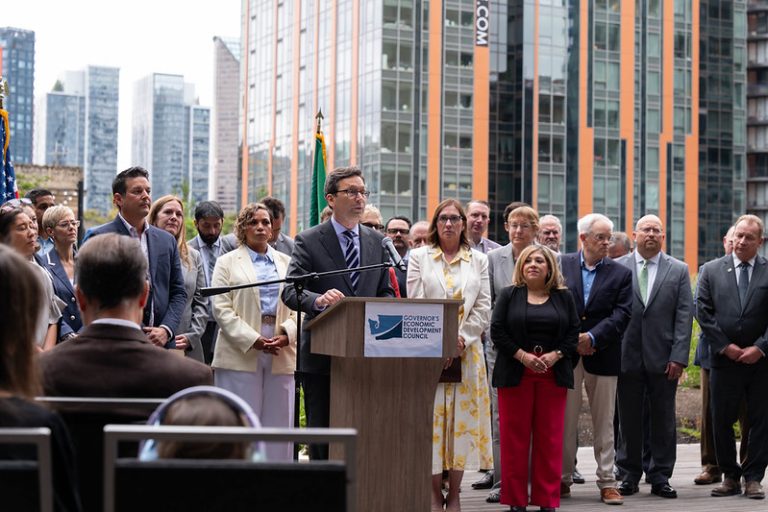
Gov. Bob Ferguson speaks at the launch of the Governor’s Economic Development Council in Seattle, June 2026. (Photo: Office of the Governor)
OLYMPIA, Wash. — Washington’s latest revenue forecast shows relatively little change in projected state tax collections, but Gov. Bob Ferguson says the state still faces an approximately $4 billion budget shortfall in the first year of its next two-year budget.
The November 16 forecast from the Washington State Economic and Revenue Forecast Council projects a modest increase in revenue over the current 2025-27 biennium. However, projections dip slightly for 2027-29 before rising again in 2029-31.
Ferguson said the state is making progress toward long-term financial stability but warned that rising costs and federal funding reductions will create significant challenges when lawmakers assemble the next budget.
“The bad news is: We now project an approximately $4 billion shortfall in the first year of the next budget. The good news is our budget situation will be stable beginning July 1, 2028.”
— Gov. Bob Ferguson
Washington Revenue Forecast Projects $94 Billion by 2031
The November forecast projects Washington will collect approximately $94.2 billion in total revenue during the 2029-31 biennium. That represents an increase of nearly $11.7 billion over the 2025-27 biennium.
The latest projections show relatively small adjustments from the September forecast.
| Budget Period | Projected Revenue | Change From September |
|---|---|---|
| 2025-27 | $76.45 billion | +$195.4 million |
| 2027-29 | $82.52 billion | -$75.4 million |
| 2029-31 | $94.21 billion | +$87.3 million |
The forecast includes revenue supporting the state’s operating budget and several dedicated accounts.
Revenue for the current biennium increased by approximately $195 million compared with September. The projection for 2027-29 declined by about $75 million, while the 2029-31 projection increased by approximately $87 million.
Economic and Revenue Forecast Council Executive Director Dave Reich said the latest economic outlook presents a mixed picture.
“The revised U.S. and Washington economic forecasts are mixed with a slightly more optimistic U.S. forecast and somewhat less optimistic Washington forecast,” Reich said.
“This led to modest changes for most revenues and a modestly improved revenue forecast in the current 2025-27 biennium and a slightly lower forecast in the next biennium.”
Ferguson Points to Spending Cuts and Millionaires Tax
Ferguson said he inherited a $16 billion budget shortfall when he took office in 2025. He credited budget reductions, spending efficiencies and the passage of the state’s Millionaires Tax with helping address the state’s financial challenges.
“When I took office last year, I inherited a $16 billion budget shortfall. I committed to working our way out of that — and we’re making progress,” Ferguson said.
He also defended changes to the state’s budgeting approach, saying previous administrations relied on overly optimistic revenue growth assumptions.
“For years, the state compounded our budget challenges by assuming we would see 4.5% growth, even if the forecast council told us that number would be lower. Now, at my insistence, we are budgeting based on our real growth.”
Ferguson also pointed to federal funding reductions under the Trump administration as a factor affecting the state’s financial outlook.
“After dealing with billions of dollars in draconian cuts imposed by the Trump Administration, voters have elected a new Congress that will help return us to budget sanity.”
— Gov. Bob Ferguson
Ferguson said the state is now on a path toward long-term financial stability, but the next budget will require difficult decisions.
“Bridging that one-year shortfall will not be easy. I’m focused on delivering a balanced budget that prioritizes core services and protecting our state’s most vulnerable, that moves our state forward.”
He plans to release his proposed 2027-29 budget by Dec. 20.
Republicans Challenge State Spending Growth
Washington House Republicans offered a different interpretation of the state’s revenue outlook, arguing that growing government spending, rather than insufficient revenue, is driving the budget challenges.
In a Nov. 12 statement, House Republicans pointed to projected state tax collections exceeding $94 billion by the 2030-31 biennium.
“Washington doesn’t have a revenue problem — it has a spending problem.”
— Washington House Republican Caucus
Republicans also argued that state spending has grown faster than inflation-adjusted revenue on a per-person basis.
The competing assessments highlight the central disagreement heading into the next legislative budget cycle: whether Washington’s financial challenges require additional revenue, spending reductions or a combination of both.
Washington Economy Shows Mixed Signals
The November forecast reflects weaker expectations for several areas of Washington’s economy, including personal income growth, employment and housing construction.
Washington added 4,800 jobs in September and October, exceeding the forecast’s expected increase of 800 jobs. However, historical revisions reduced previously estimated employment levels by 5,300 jobs.
The state’s unemployment rate declined to 4.8% in September, down from 5.2% in April, May and June.
Forecasters expect employment growth to remain slow, averaging approximately 0.7% annually from 2027 through 2031.
Housing construction also showed signs of weakness. Washington permitted an estimated 31,800 housing units in the third quarter, down from 49,800 in the second quarter. The latest figure also fell below the September forecast’s projection of 42,700 units.
Seattle-area home prices declined 2% over the year, while consumer prices in the Seattle area increased 4.1% between October 2025 and October 2026.
The forecast also identifies geopolitical conflicts, trade policy, elevated interest rates and declining investment as potential risks to economic growth.
Transportation Revenue Forecast Also Improves Slightly
The state’s transportation revenue forecast showed modest increases across all three budget periods compared with September.
Transportation revenue is now projected at approximately $8.8 billion for 2025-27, an increase of $68.6 million.
The forecast for 2027-29 increased by $76.8 million to approximately $10.6 billion. The 2029-31 projection increased by $74 million to approximately $10 billion.
The upward revisions reflect higher expected collections from the motor vehicle fuel tax and tolls.
Despite those increases, transportation revenue through 2029 remains projected to be $147 million below the February 2026 forecast used when lawmakers approved a supplemental budget in March.
Next Budget Proposal Expected in December
Ferguson is developing his proposed 2027-29 operating budget, which he plans to release by Dec. 20.
The Legislature will face the challenge of balancing the first year of the next budget while accounting for rising costs, federal funding reductions and projected revenue.
The Economic and Revenue Forecast Council is scheduled to complete its next revenue forecast by March 20, 2027. Its forecasts help guide lawmakers and the governor as they develop the state’s operating and transportation budgets.
Frequently Asked Questions
About the Author