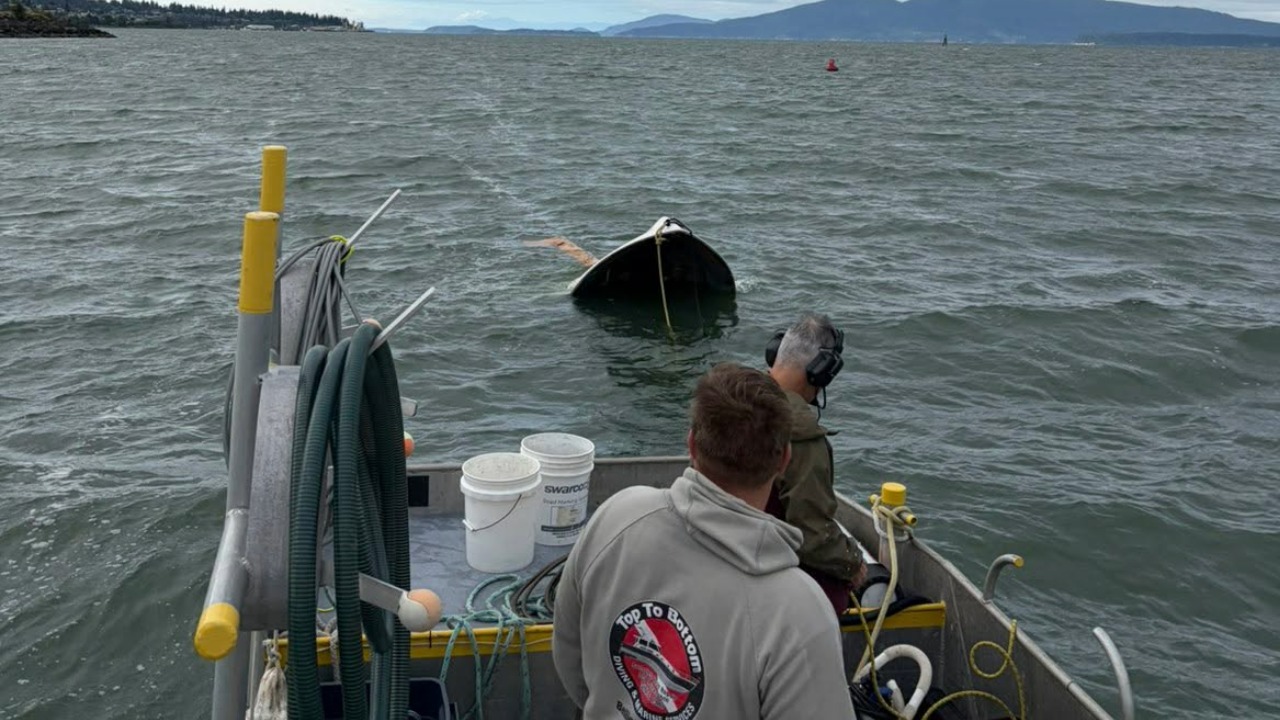
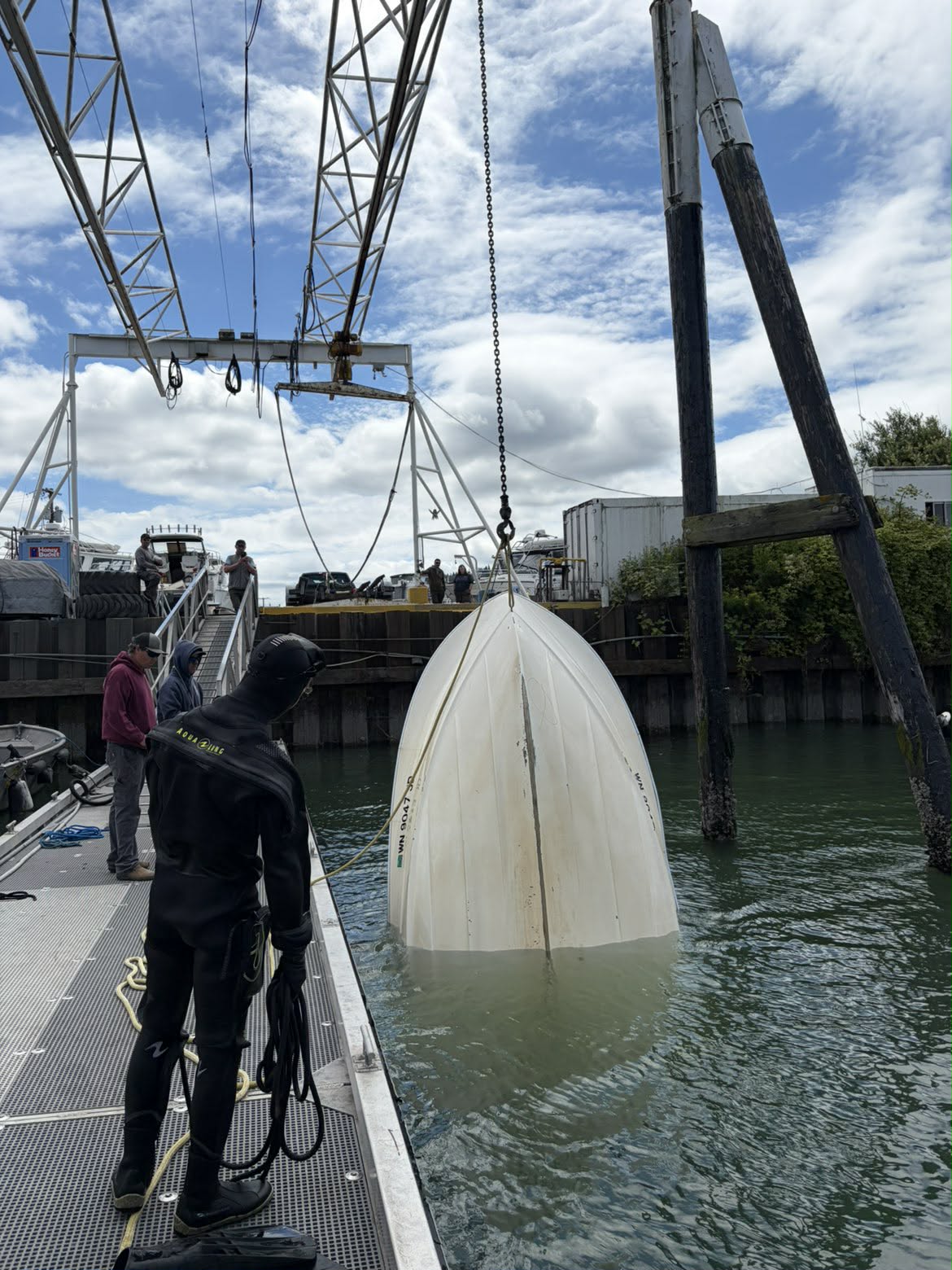
Crews with Top to Bottom Diving and Marine Services prepare to recover the 18-foot powerboat involved in the fatal July 4 capsizing in Bellingham Bay. The vessel was recovered Wednesday as investigators continued working to determine what caused the incident that claimed the life of 49-year-old Kristopher DeBoer. (Photo courtesy of Kaiden Pope at Top to Bottom Diving and Marine Services)
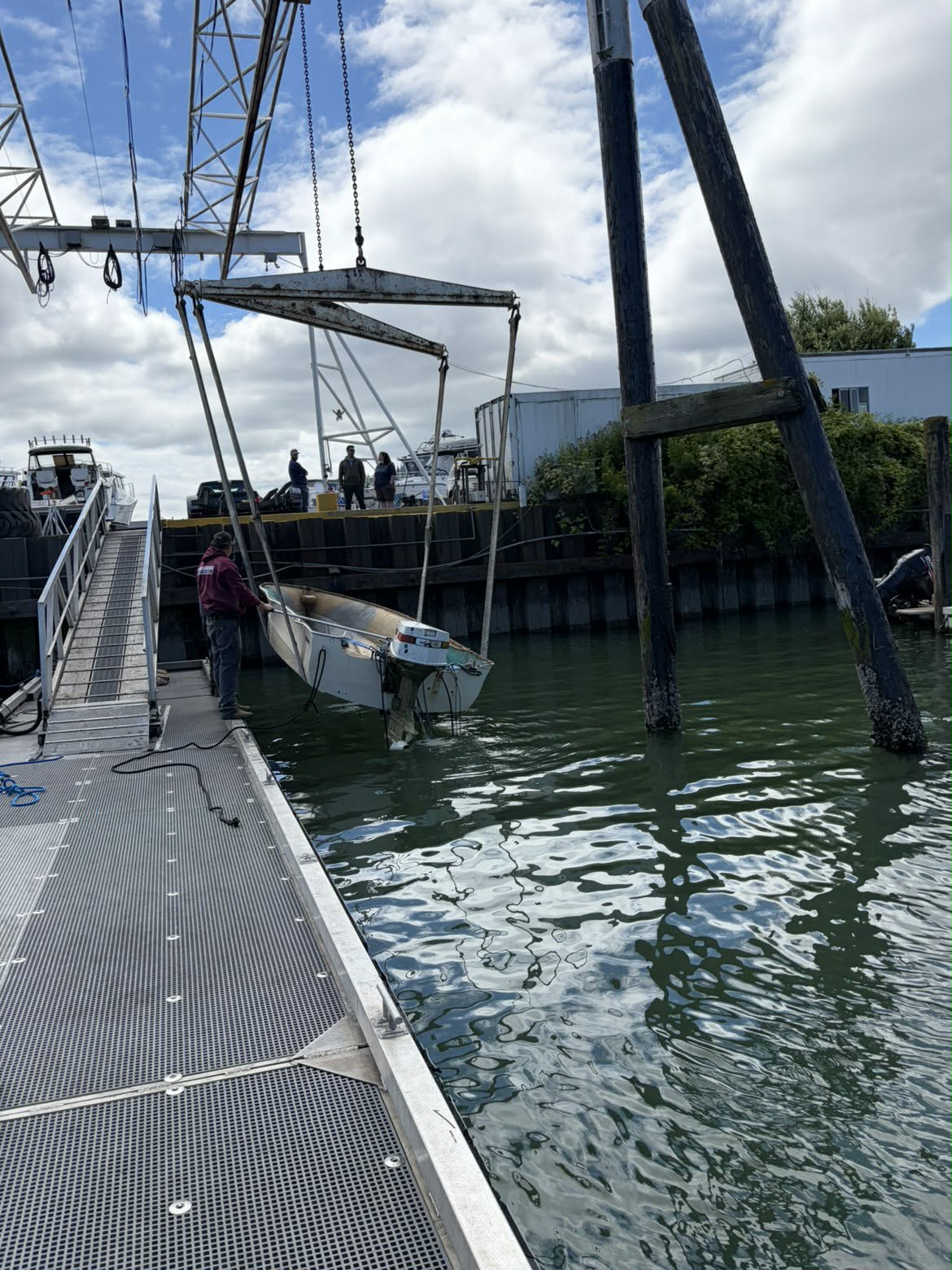
BELLINGHAM, Wash. — Recovery crews with Top to Bottom Diving and Marine Services recovered the 18-foot powerboat involved in Saturday’s fatal Bellingham Bay capsizing Wednesday afternoon. Meanwhile, the Bellingham Fire Department released new details describing the nearly 30-minute rescue effort that followed the Fourth of July tragedy.
“Our units on the shore were able to quickly get a visual of the capsized boat after the dispatch. After approximately 30 minutes the vessel was able to be partially righted by the USCG and a victim was found in the water. The victim was taken on board the Salish Star and resuscitation efforts began.”
Capt. Dustin Michaelis, Bellingham Fire Department
“Our units on the shore were able to quickly get a visual of the capsized boat after the dispatch,” Capt. Dustin Michaelis with the Bellingham Fire Department said. “After approximately 30 minutes the vessel was able to be partially righted by the USCG and a victim was found in the water. The victim was taken on board the Salish Star and resuscitation efforts began.”
The victim, identified as 49-year-old Kristopher DeBoer, was alone when his boat overturned several hundred yards off Zuanich Park shortly before 6 p.m. July 4. Coast Guard and Bellingham Fire crews pulled him from the water and fought to save his life.
Despite those efforts, he died.
“Our deepest condolences go out to the family, friends and loved ones of the man who was lost in this tragic incident,” said Lt. William Trumper, commanding officer of Coast Guard Station Bellingham.
New Details Reveal Rescue Timeline
Bellingham Fire crews received the call at 5:57 p.m. An engine company and a battalion chief responded to the waterfront. They quickly spotted the overturned boat several hundred yards offshore.
Meanwhile, the Coast Guard diverted a 45-foot Response Boat-Medium from Station Bellingham. Bellingham Fire’s marine rescue vessel, Salish Star, joined the response after clearing an unrelated medical call.
Rescuers spent about 30 minutes working to reach the victim. Coast Guard crews eventually partially righted the overturned boat and found the man in the water.
Two Coast Guard crew members boarded the Salish Star to help firefighters recover the unresponsive man. Crews immediately started CPR and advanced life-saving care.
The incident commander also requested additional firefighters and EMS personnel to meet the boat at Coast Guard Station Bellingham, 28 Bellwether Way. Crews continued resuscitation efforts after returning to shore. However, they could not revive the man.
Investigation Continues
The Coast Guard said weather conditions remained relatively calm during the incident. Winds blew from the south at 11 mph, waves measured about 1 foot, the air temperature reached 62 degrees and the water temperature measured just 51 degrees.
Investigators continue working to determine what caused the 18-foot vessel to capsize.
Fire officials urged boaters to wear a life jacket every time they head onto the water. They also recommend checking weather and water conditions before leaving shore, carrying a charged phone or marine radio, and telling someone where you plan to go.
Officials also urged anyone whose boat capsizes to stay with the vessel whenever it is safe. Rescuers can spot a boat much more easily than a person in the water. Even during the summer, cold water can quickly cause exhaustion and hypothermia.
Frequently Asked Questions
About the Author