

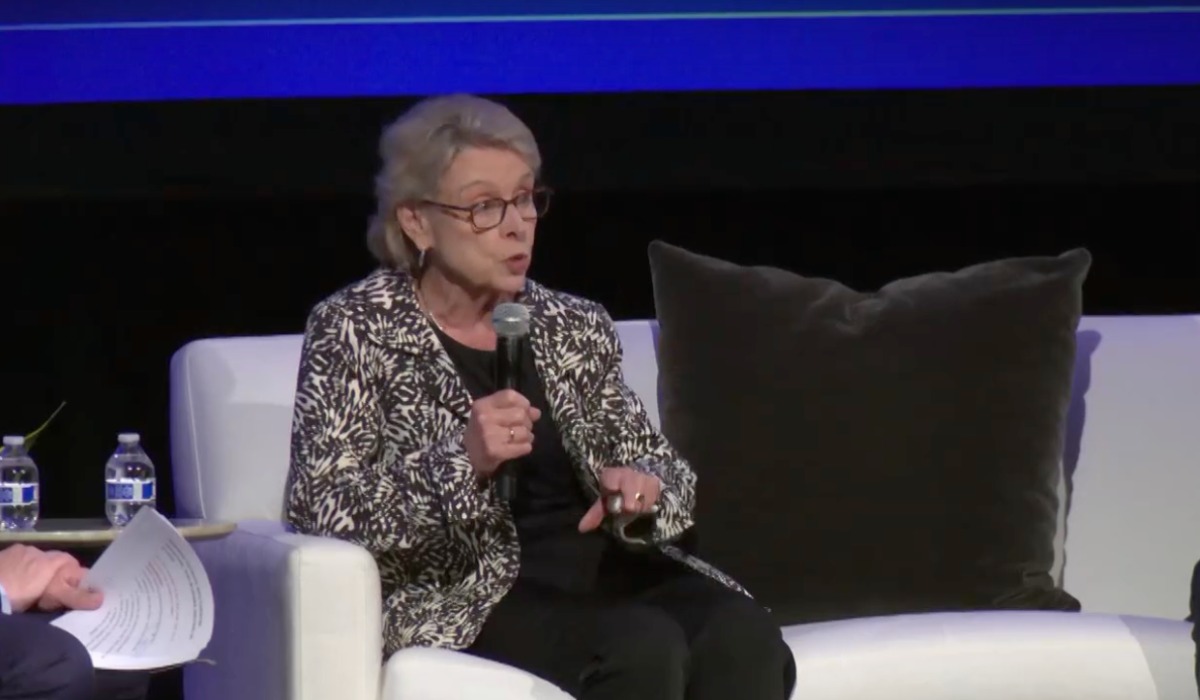
Former Washington Gov. Christine Gregoire speaks during a recent Association of Washington Business event discussing taxes, economic growth and Washington’s business climate. (Photo: Video screenshot courtesy of TVW)
BELLINGHAM, Wash. — Rising energy costs, government budget concerns and growing uncertainty around the broader economy are beginning to show up in local data across Northwest Washington, even as some financial institutions and businesses continue to report strong growth.
Recent reports from local governments, commercial real estate analysts and business groups paint a mixed picture across Whatcom County in Bellingham, Ferndale, Lynden, and in Skagit County in Mount Vernon, Burlington and Sedro-Woolley.
While local credit unions and some commercial sectors remain stable, downtown vacancies, public budget shortfalls and concerns about Washington’s tax climate continue to fuel debate about the region’s long-term economic direction.
First, the Good News: Local Credit Unions Show Continued Growth
Despite concerns about vacancies and government budgets, local financial institutions continue reporting strong numbers.
North Coast Credit Union reported total assets surpassed $400 million for the first time in 2025, reaching $420.7 million, according to the credit union’s annual report.
The organization funded more than $263 million in member loans during the year, including $112 million in real estate loans, $89 million in business loans and $62 million in consumer loans.
We continue to possess a balanced loan portfolio, a strong capitalization rate and the appropriate levels of liquidity that provide the basis for a continued safe and sound financial future.
— A.C. Griffith, President and CEO, North Coast Credit Union
The credit union also highlighted community support programs tied to historic flooding impacts in Whatcom County and Skagit County.
North Coast operates branches in Whatcom and Skagit counties in Bellingham, Ferndale, Mount Vernon, Anacortes and Sedro-Woolley.
Broader Area Economic Concerns
Whatcom County leaders recently warned employees that layoffs and service reductions could be necessary as expenses continue to outpace revenue heading into the county’s next budget cycle.
County Executive Satpal Sidhu said the county is reviewing hiring, schedules and operational costs as officials work to close projected budget gaps for 2027 and 2028. Officials later implemented immediate austerity measures aimed at reducing spending.
The warnings come as local governments across Washington continue facing rising labor, fuel and infrastructure costs.
Downtown Bellingham Vacancy Rates Climb
Commercial vacancy rates in downtown Bellingham have also become a growing concern for city leaders and business owners.
A recent city report found roughly 14% of the downtown pedestrian core now sits vacant, with officials describing the concentration of empty storefronts as unusually high for a city Bellingham’s size.
Additional commercial real estate reports showed downtown retail and office vacancies increasing through late 2025 and early 2026, particularly around older urban core properties and larger retail spaces.
Sunset Square vacancies increased after the closures of several major retailers, while Barkley Village continued to outperform much of the city with lower vacancy rates and stronger demand.
City leaders have launched the Downtown Forward initiative in an effort to address vacant buildings and improve activity in the urban core.
Businesses Leaving Seattle Raise Questions Statewide
While Northwest Washington has not seen a wave of corporate headquarters departures similar to Seattle, some major regional employers have expanded operations outside Washington amid ongoing concerns about taxes, regulations and operating costs.
Sedro-Woolley-based Janicki Industries announced a major expansion into Nevada in recent years, adding manufacturing capacity outside Washington as business leaders across the state increasingly debate competitiveness, energy costs and long-term economic policy.
The move drew attention across Skagit County because Janicki remains one of the region’s largest advanced manufacturing employers and a major economic driver in Sedro-Woolley.
Former Gov. Christine Gregoire recently warned during an Association of Washington Business event that lawmakers underestimate how taxes and costs influence wealthy residents and employers to relocate or expand elsewhere.
“We were already tied with Hawaii for the highest estate tax in the country at 20%, and now we’ve gone to 35%,” former Gov. Christine Gregoire said. “We’re not just the highest anymore. We’re beyond the highest.”
As a Democrat and former Washington governor, Gregoire’s recent criticism holds weight. She challenged current state lawmakers over tax policy and warned lawmakers they underestimate how tax policy can influence wealthy residents and businesses to leave Washington.
When they leave, they stop paying taxes when they leave. They stop giving significant philanthropy, which would otherwise be necessary by government. Do you understand the consequences of what you’re doing? And the answer is no.
— Former Gov. Christine Gregoire, Association of Washington Business
Meanwhile, reports tied to Starbucks’ expansion of corporate operations into Tennessee and several high-profile executive relocations have fueled concerns from business groups about long-term competitiveness.
Still, many local economists note Northwest Washington has historically benefited from a more diversified regional economy built around agriculture, manufacturing, cross-border trade, tourism, health care and logistics.
Energy Concerns Remain Part of the Conversation
Energy demand and utility costs are also becoming a larger issue throughout Washington.
Northwest Washington has experienced major economic shifts tied to energy prices and industrial costs before. The closure of the Intalco aluminum smelter in Ferndale eliminated hundreds of family-wage jobs after years of pressure from volatile aluminum markets and rising industrial power costs. Cherry Point refiners and manufacturing leaders have also repeatedly warned state lawmakers that fuel policies, carbon costs and regulatory uncertainty could affect Washington’s long-term competitiveness.
Seattle officials are currently considering restrictions on new large-scale data centers because of concerns surrounding future power demand tied to AI and tech growth.
In Northwest Washington, rising fuel and electricity costs continue impacting transportation, food production, manufacturing and small business operations, particularly for companies already operating on narrow margins.
For now, the region’s economy remains stable overall, but increasing vacancies, public budget warnings and broader uncertainty continue raising questions about what the next several years could look like for local businesses and taxpayers.
Frequently Asked Questions
About the Author



1 thought on “Mixed Economic Signals Emerge Across Northwest Washington”