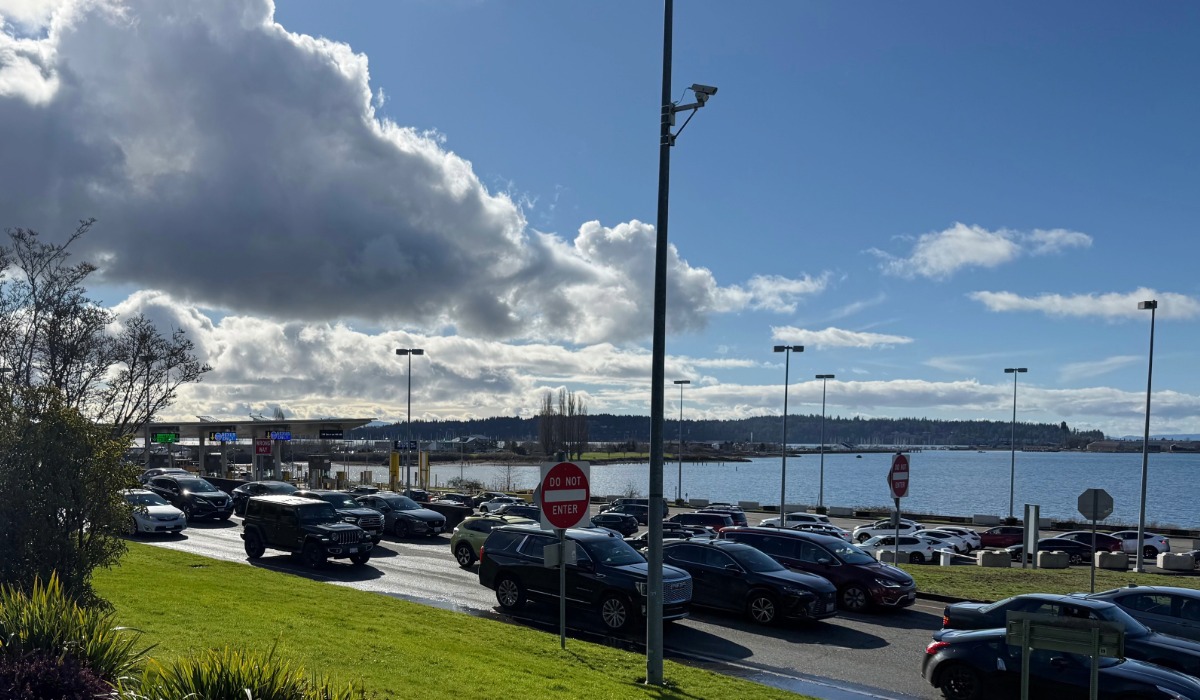
Peace Arch port of entry in Blaine, Washington, where travelers experienced longer wait times despite sharply reduced cross-border traffic from Canada. (PNW Daily)
BLAINE, Wash. — Travelers entering the United States through the Peace Arch crossing experienced slower processing over the weekend despite lower than average traffic at the border.
Officials with U.S. Customs and Border Protection’s Seattle Field Office urged foreign travelers Monday to complete their Form I-94 online before arriving at the border in order to speed up entry processing.
“Are you a foreign traveler planning on visiting the United States?” Acting Executive Assistant Commissioner, CBP Office of Field Operations, Diane J. Sabatino said Monday. “Apply for your I-94 before entering the U.S. so that you can expedite your travels and ensure more efficient processing.”
The advisory comes as wait times at ports of entry have stretched longer than expected during the weekend, even though cross-border traffic remains well below normal levels.
Delays occur despite lower border traffic
The delays come as cross-border travel between British Columbia and Whatcom County has fallen sharply over the past year.
As PNW Daily previously reported, data compiled by the Whatcom Council of Governments shows British Columbia–plated vehicles entering Washington dropped roughly 36 percent in 2025 compared with the previous year.
The decline has been widely attributed to political tensions, tariffs, and concerns among some Canadian travelers about increased enforcement activity near the border.
Despite the reduced traffic, travelers still encountered delays over the weekend.
During a livestream Sunday, PNW Daily observed four standard vehicle entry lanes open at Peace Arch with two NEXUS lanes operating.
Officers are also collecting expanded biometric information during inspections, which can lengthen the processing time for each vehicle.
CBP issued the new rule last December which amended existing DHS regulations to collect facial biometrics from all noncitizens upon entry and exit at airports, land ports, seaports, and other authorized points of departure.
“This final rule marks a major milestone towards our efforts to successfully implement the Biometric Entry/Exit mandate and strengthen the security of the United States,” Sabatino said in December. “With increased funding to support this critical mission, we will continue to expand facial biometrics and advanced technology for identity verification to further secure and innovate the entry/exit process at air, land, and sea.”
The increase in exit checkpoints and other entry data collection increases are a continuation of Trump Administration policy abandoned in favor of other priorities under the Biden Administration. In early 2017, President Donald Trump issued an Executive Order requiring “expedited” completion and implementation of biometric entry-exit.
CBP urges travelers to apply online
Many foreign visitors entering the United States must obtain a Form I-94, which serves as the official record of lawful admission.
According to CBP, the form is required for most foreign travelers entering the U.S., with several exceptions including:
- U.S. citizens
- Returning lawful permanent residents
- Travelers with immigrant visas
- Most Canadian citizens visiting briefly or transiting through the country
Travelers entering by land or ferry can apply online for a provisional I-94 before reaching the border. Officials say completing the form in advance can shorten inspection times at ports of entry.
The fee increased from $6 to $30 last year as a part of Trump Administration efforts to increase monetization of foreign travel into the U.S.
Once admitted to the United States, travelers can also retrieve their most recent I-94 record online. CBP maintains admission records dating back to 1983 for most entry categories.
Exit enforcement continues at border
The slower processing comes as CBP continues operating exit-monitoring checkpoints near the border.
PNW Daily has documented the checkpoints during livestream coverage over the past three weeks as federal agents track travelers leaving the country.
Officials have not announced how long the current enforcement emphasis will continue.
About the Author