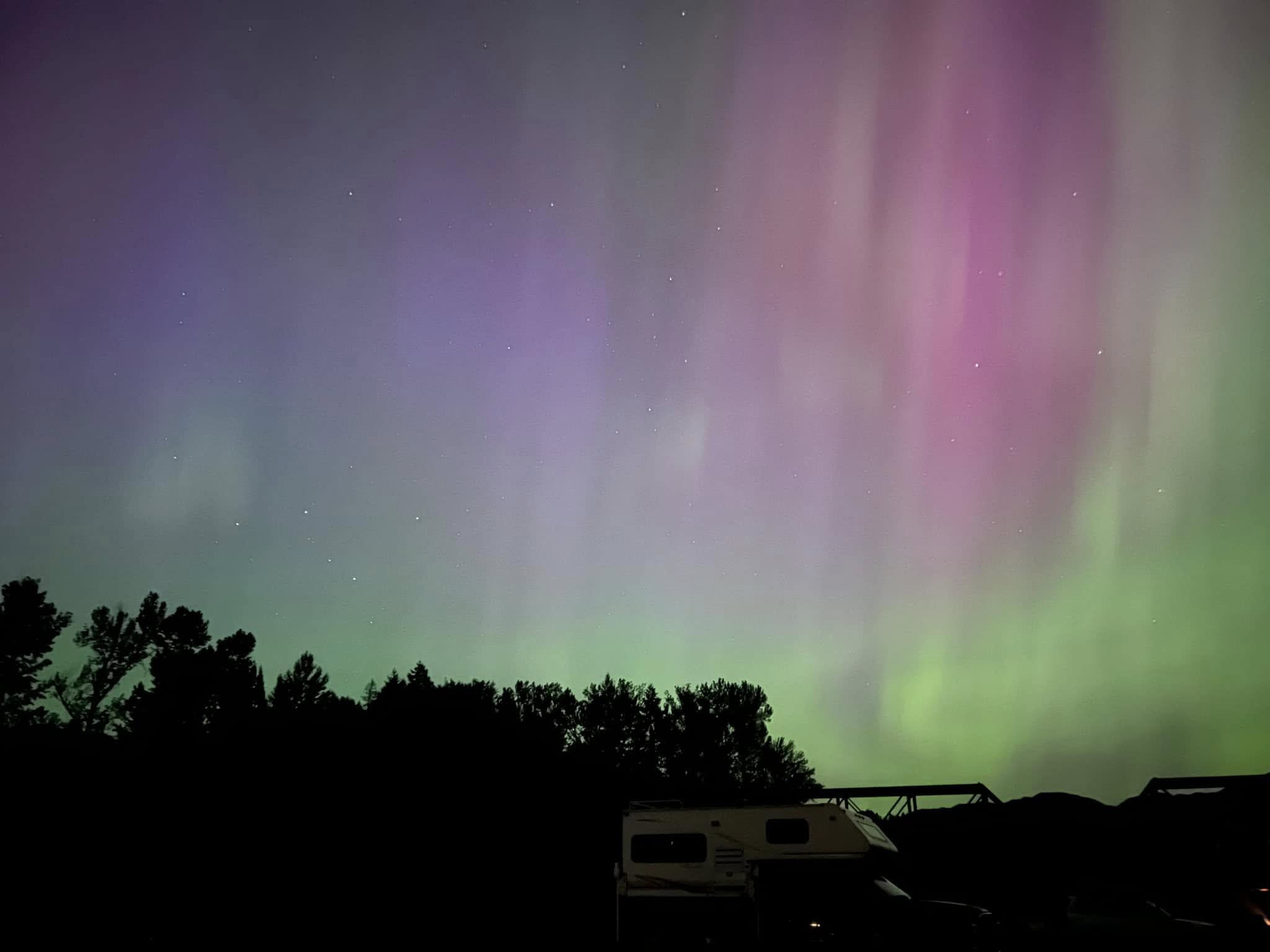
The northern lights could light up the night sky tonight across the Pacific Northwest. Pictured are vehicles at the confluence of the Nooksack River, May 2024. (PNW Daily staff)
BLAINE, Wash. — Residents across the Pacific Northwest could see the northern lights tonight after the National Weather Service Seattle office issued a G4 geomagnetic storm watch tied to an incoming solar eruption.
Forecasters say a coronal mass ejection, known as a CME, is expected to reach Earth late tonight. The storm could push the aurora borealis farther south than usual, making it visible across much of Washington and Oregon.
If conditions align, the lights could appear shortly after dark and remain visible into the early morning hours.
What a G4 storm means
A CME is a massive burst of charged particles released from the sun. When those particles collide with Earth’s magnetic field, they can trigger glowing waves of light in the upper atmosphere.
A G4 storm ranks as severe on NOAA’s five-point scale. These storms often expand the aurora’s reach far beyond polar regions.
During strong events, people in the Pacific Northwest can see auroras from beaches, mountain passes, and even suburban neighborhoods.
Recent aurora displays in the PNW
The region last saw a widespread aurora event in November 2025, when residents across Western Washington shared photos of green and red ribbons stretching across the night sky.
An even stronger series of storms struck in May 2024. Those solar eruptions produced one of the most intense geomagnetic events in decades. Auroras appeared as far south as Florida, making national headlines.
Forecasters say tonight’s storm could create similar viewing conditions in the Northwest if skies remain clear.
Best times and places to look
Experts recommend finding a dark location away from city lights. Viewers should look toward the northern horizon after sunset.
High elevations and open shorelines often provide better views. Long-exposure photos can capture colors that the naked eye may miss.
Cloud cover will play a major role in visibility.
Other impacts of geomagnetic storms
Strong solar storms can affect GPS signals, radio communications, and some satellite systems. Power operators and aviation networks monitor these events closely.
The Space Weather Prediction Center will continue tracking the storm overnight.
About the Author