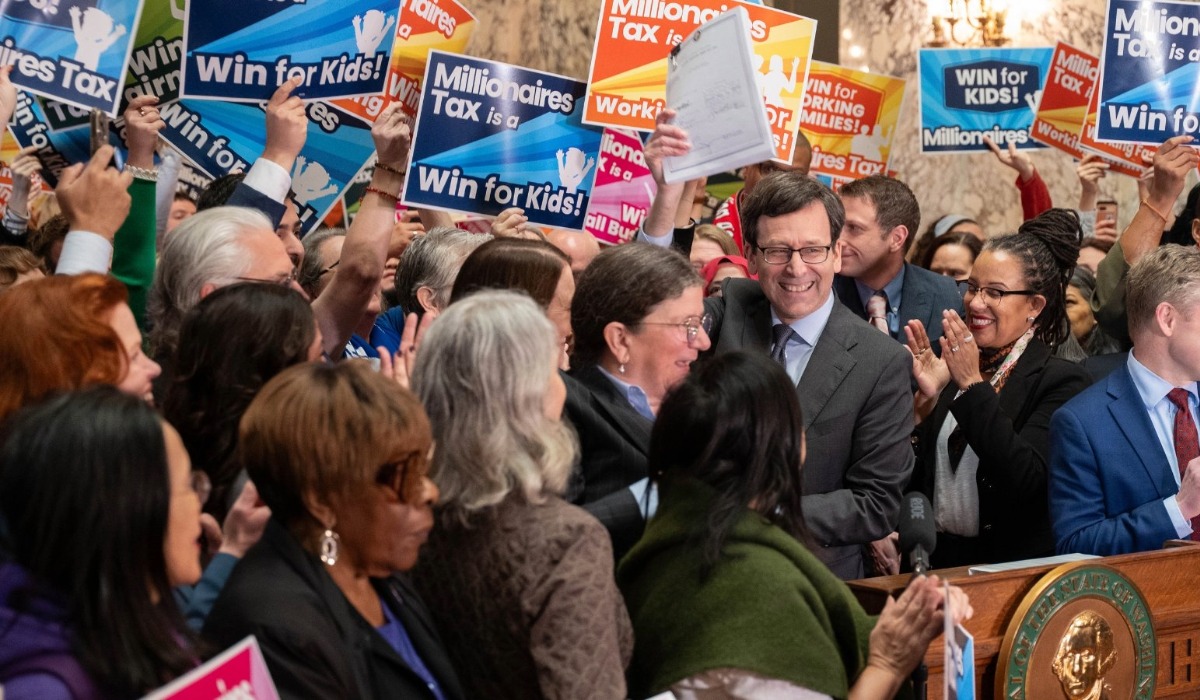
Washington’s Millionaires Tax was signed into law Monday, but a lawsuit filed the same day is already challenging its constitutionality. (Gov. Bob Ferguson)
OLYMPIA — Governor Bob Ferguson signed the Millionaires’ Tax into law Monday morning, capping a legislative session his office called “historic.” The ink was barely dry before opponents announced a constitutional lawsuit that could unravel the measure.
“We’re rebalancing our unfair system,” Ferguson said at the signing ceremony. “This sends significant dollars back to Washington families and small businesses.”
The legislation, Senate Bill 6346, imposes a 9.9% tax on individual income above $1 million annually. Ferguson and Democratic supporters call it a long-overdue correction to Washington’s regressive tax structure. The system relies heavily on sales taxes and falls disproportionately on lower-income residents.
“With this bill, we’re going to begin to right a historic wrong that has plagued our state for nearly 100 years, and made our tax system one of the worst and most regressive in the entire country,” Sen. Jamie Pedersen said. “We’ve asked Washington’s working families for far too long to shoulder far too much of the tax burden for the things we care about, and we have not asked enough of our wealthiest neighbors.”
The new revenue will expand tax credits for working families. It will also fund free school meals for every K-12 student in the state. In addition, it delivers what supporters call the largest small business tax break in state history.
“This is much more than a Millionaires’ Tax bill,” said Rep. Joe Fitzgibbon. “This is a tax reform bill. At a time when so many Washington families are struggling to make ends meet, we are going to make it more affordable place to live, and a better place to work and do business.”
The Constitutional Question
The legal argument centers on a foundational question in Washington law: is income property? Washington courts have said yes for nearly a century.
Hours after the signing, the Citizen Action Defense Fund (CADF) issued a press release announcing it had retained former Washington Attorney General Rob McKenna to lead a constitutional challenge to the law. The organization says it expects to file suit within days.
Under Article VII of the Washington State Constitution, property must be taxed uniformly. A graduated income tax, critics argue, by definition violates that uniformity requirement.
“Washington’s constitution is clear, and the courts have been equally clear for nearly a century — income is property, and progressive income taxes are unconstitutional under existing law.”
— Rob McKenna, Former Washington Attorney General & Lead Counsel, CADF
CADF Executive Director Jackson Maynard was blunt about his organization’s intent. “Since lawmakers and the Governor have chosen to ignore both the constitution and decades of settled case law, we will act,” he said. “This lawsuit is about upholding the rule of law and ensuring that Washingtonians are not subjected to an unconstitutional tax scheme.”
McKenna raised these concerns during the legislative session. He released a legal memorandum outlining what he described as the bill’s constitutional defects. At the time, he urged lawmakers to pursue a constitutional amendment instead. That path would require a two-thirds legislative vote and approval from voters.
A Deliberate Political Bet
However, Democratic lawmakers appear to have passed the bill expecting a legal fight. The Washington State Supreme Court set a recent precedent in 2023. It upheld the state’s capital gains tax, ruling it was an excise tax rather than an income tax.
Supporters of SB 6346 believe a similar argument could succeed. Alternatively, they believe the court may revisit the century-old classification of income as property.
Republicans pushed back hard during the session. At a February committee hearing, citizen Eric Lundberg told lawmakers the bill was “the most unpopular bill in Washington state history” and questioned whether public testimony would have any real influence. The Washington State GOP criticized Democrats for rejecting a floor amendment that would have explicitly limited the tax to millionaires only.
Whatcom County lawmaker Alicia Rule voted no on the legislation.
What the Money Does
If upheld, the law would have broad impacts. The expansion of the Working Families Tax Credit will send direct payments to nearly 460,000 additional Washington households.
Free breakfast and lunch for all public K-12 students statewide will eliminate a persistent source of financial stress for families. The measure also removes the sales tax from baby diapers.
For small business owners, the package includes substantial tax relief. Ferguson has described it as the largest reduction in small business taxes the state has ever enacted.
The Bigger Picture: A Transformed Tax Code
The Millionaires’ Tax arrives as the capstone of a session Ferguson’s office is already calling transformational. Lawmakers approved $1.5 billion for road and bridge maintenance over six years. The funding targets 212 structurally deficient bridges statewide. Lawmakers also committed more than $200 million toward affordable housing. Washington now also bans immigration enforcement officers from wearing masks during operations.
Whether the Millionaires’ Tax endures as law, or becomes the next major constitutional fight at the state Supreme Court, may depend on how the justices weigh nearly a century of precedent against a Democratic legislative majority determined to reshape who pays for state government. PNW Daily will continue to report as the legal challenge develops.
About the Author