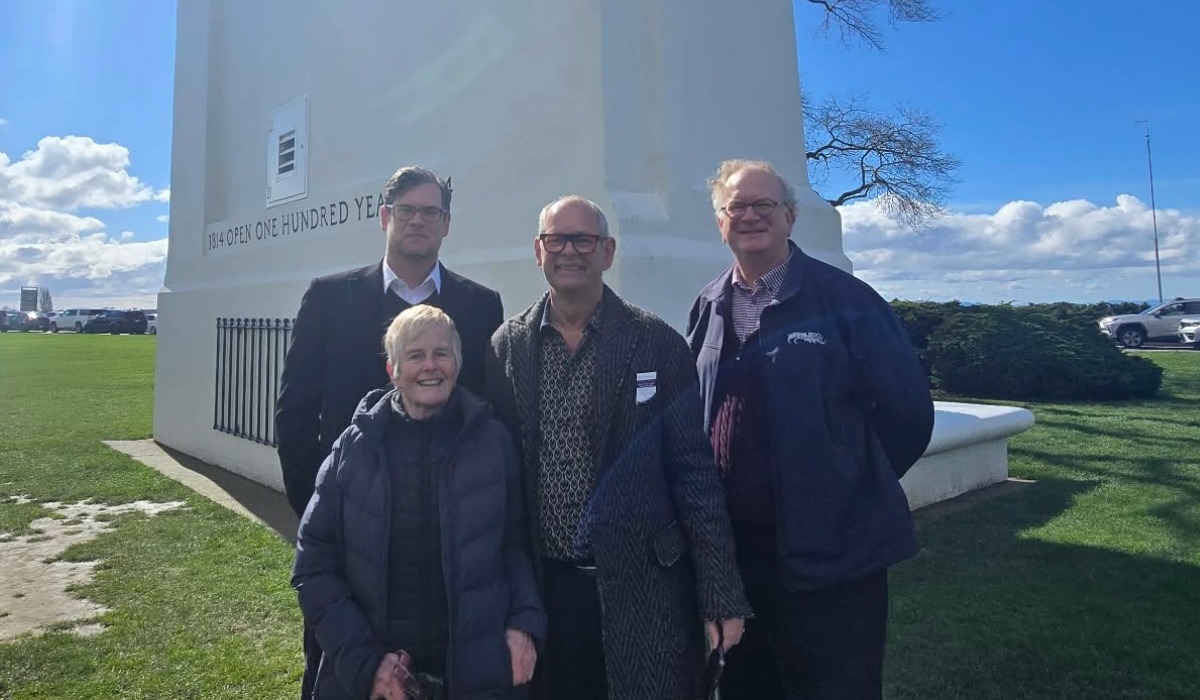
Local Canadian and U.S. officials spoke at the Peace, Love, and a Handshake rally at Peace Arch Park. Pictured are MP Ernie Klassen, Counselors Christopher Trevelyan and Anthony Manning, and Blaine Mayor Mary Steward. (Photo courtesy Christopher Trevelyan FB)
BLAINE, Wash. — Dozens gathered Saturday at Peace Arch Park to mark one year since the first “Peace, Love and a Handshake” rally, a cross-border demonstration opposing tariffs and political rhetoric around annexation.
Organizers said the anniversary reflects a year of demonstrations focused on democracy, sovereignty, and long-standing ties between the United States and Canada.
“We’re here calling on all citizens of democratic societies around the world to push back against fascism and push back against this unasked for war,” Canadian organizer Haidee Landry said.
Landry also announced several “No Tyrants” rallies planned across Canada, including a march in Vancouver on March 28.
At the same time, those events will coincide with multiple “No Kings” rallies scheduled south of the 49th parallel. Organizers say demonstrations are planned in Whatcom County, Skagit County, and across Washington.
“We’re looking farther than just our neighbors here,” Landry said. “We’re really looking for the whole world to stand up.”
Elected officials and community leaders speak
This year’s anniversary event included speakers from both sides of the border. Blaine Mayor Mary Lou Steward also spoke at the event, along with former Blaine City Council member Eric Lewis. Steward is a dual citizen of Canada and the United States.
Canadian Member of Parliament Ernie Klassen, who represents South Surrey–White Rock and serves as Parliamentary Secretary to the Minister of Fisheries, spoke at the rally.
“I don’t consider myself just a Canadian citizen, I consider myself to be a citizen of the world,” Klassen said. “The mayor, Mary, mentioned someone asking what can we accomplish by meeting here and she said maybe nothing. You know what, you’ve already accomplished something by bringing neighbors together.”
He was joined by Councillor Anthony Manning and Christopher Trevelyan, who emphasized themes of solidarity and friendship.
“I’m a high school teacher, I teach history,” Trevelyan said. “I hear these drums beating,” he added, referencing parallels he sees with the geopolitical climate before World War I.
Trevelyan said Canadians must stand with Americans who oppose policies that “drive a wedge between us and economically damage our nation and their own communities.”
From one person with a flag to a cross-border movement
What began as a solitary protest has grown into a recurring cross-border gathering.
Landry first arrived at the Peace Arch alone with handmade signs and a Canadian flag mounted on a hockey stick. She stood near the monument as passersby stopped, asked questions, and joined the conversation.
“What we’ve seen in this last year is that one person standing by themselves on the side of a street showing their resistance, you don’t need to be a big group, just one person can really make a difference,” Landry said. “And if you’re positive, people will follow you. So I hope everyone leaves here today feeling inspired.”
PNW Daily captured that first moment Landry was that one person standing alone during a livestream from the park in March 2025. Since then, those interactions have evolved into biweekly rallies that continued through changing weather and fluctuating turnout.
Crowd sizes have ranged from a handful to hundreds over the past year. However, organizers say the goal has never been attendance.
Instead, they point to consistency as the message.
A year of rallies tied to tariffs and rhetoric
The movement began in March 2025 after President Donald Trump announced tariffs on Canadian goods and floated the idea of Canada becoming the “51st state.”
Soon after, participants began meeting every two weeks at the monument.
Over time, the gatherings developed a routine. Organizers brought coffee, creamer, homemade cookies, and Timbits. Some events drew larger crowds, while others remained small and informal.
Still, participants say the message has remained consistent. They continue to oppose political rhetoric they believe harms democratic norms and cross-border relationships.
Why the Peace Arch remains central
Organizers say the location carries deep historical and symbolic significance that extends far beyond the current moment.
The Peace Arch monument, dedicated in 1921, was built to commemorate more than a century of peace between the United States and Canada following the War of 1812. It bears the inscription “Children of a Common Mother,” reflecting the shared history between the two nations.
The site has also played a role in modern diplomacy. A plaque near the monument notes that U.S. President Lyndon B. Johnson and Canadian Prime Minister Lester B. Pearson met at the Peace Arch in connection with the Columbia River Treaty, one of the most significant cross-border water management agreements between the two countries.
Over the decades, the park has hosted high-level meetings, ceremonies, and public gatherings that reflect the relationship between the two nations.
In addition, Peace Arch Park remains one of the few places along the border where people from both countries can meet face to face without formally crossing through a checkpoint. As a result, it has long served as a gathering place for celebrations, protests, and international events.
For organizers, that history is central to why the rallies continue here.
They say the monument represents one of the longest undefended borders in the world and a reminder that cooperation between the two countries has historically defined the relationship more than conflict.
About the Author