

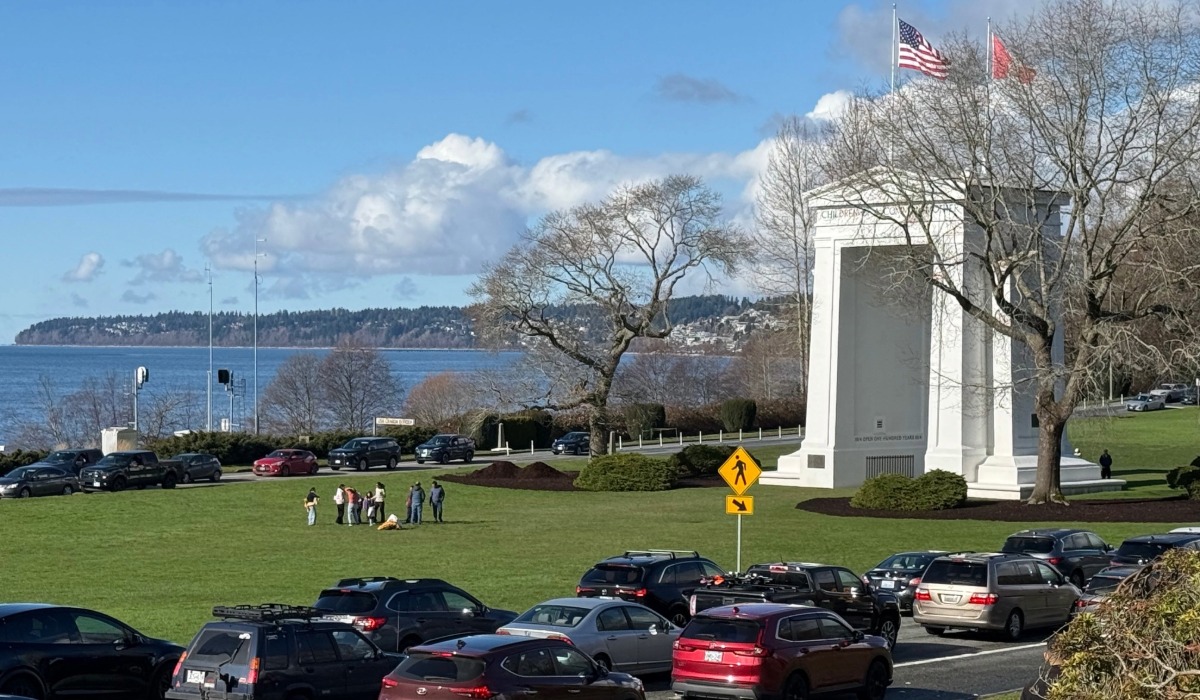
Traffic headed south from Canada at the Peace Arch border crossings has dropped sharply over the past year according to data compiled by the Whatcom Council of Governments. (PNW Daily)
BLAINE, Wash. — Cross-border travel between British Columbia and Whatcom County has dropped sharply over the past year as political tensions and tariffs reshape travel patterns across the U.S.–Canada border.
Businesses from Blaine to Bellingham saw traffic disappear and made staffing cuts over the last year. In Blaine, sidewalk construction saw much of the downtown fenced off from local restaurants, exacerbating the problem forcing downsized employees to relocate to other areas of the state.
New data compiled by the Whatcom Council of Governments shows a steep decline in British Columbia–registered vehicles traveling south into Washington at the region’s four major crossings: Peace Arch, Pacific Highway, Lynden, and Sumas.
The numbers come as demonstrators continue gathering near the Peace Arch monument in Blaine, sparked by the announcement of the first tariffs on Canadian goods a year ago. A group known as Peace Love and a Handshake has been holding biweekly rallies calling for stronger relations between the United States and Canada and end of new Trump administration tariffs.
PNW Daily previously documented several of the group’s demonstrations at the international park, where participants wave American and Canadian flags and promote cross-border friendship amid rising tensions over tariffs and trade disputes.
Travel drop began early last year
Regional transportation analysts say the downturn began early last year and accelerated throughout 2025.
According to the data, British Columbia–plated vehicles entering Washington dropped about 36 percent across 2025 compared with the previous year.
Many Canadians say the exit checkpoints and violent immigration enforcement make the prospect of crossing the border seem intimidating.
“Business community in Blaine begging Canadians to visit for day trips to spend their money,” Canadian Hilary Wollis said. “Meanwhile, the CBP doing everything possible to ensure it’s the worst day ever for Canadian tourists.”
Monthly declines have remained significant in many cases, with some months showing drops of more than 50 percent compared with the same period the previous year.
The trend coincided with rising political tensions, including new tariffs and disputes between the two countries, as well as broader economic factors affecting discretionary travel.
“Canadian travelers south aren’t growing in number, and with these new habits, they will be hard to change back in the years ahead,” Fram Woods said to one PNW Daily report on reduced traffic. “I use to be down twice a week now I might go down once every couple of months.”
Peace Arch gatherings highlight cross-border concerns
At the Peace Arch International Park, demonstrators say the economic and cultural ties between Whatcom County and the Lower Mainland make the decline in cross-border travel especially noticeable.
The monument itself was built as a symbol of peaceful relations between the United States and Canada, with the inscription “Children of a Common Mother.”
Members of the Peace Love and a Handshake group have gathered near the monument every two weeks, calling for improved diplomatic relations and encouraging Canadians and Americans to maintain the long tradition of cross-border friendship.
PNW Daily has previously reported from several of those events, where demonstrators say tariffs and political rhetoric have strained a relationship that historically included frequent shopping trips, tourism, and family visits across the border.
Cross-border vehicle travel (B.C. plates entering Whatcom County)
| Year | Estimated B.C. Vehicle Trips | Change |
|---|---|---|
| 2023 | ~2.35 million | — |
| 2024 | ~2.60 million | +11% |
| 2025 | ~1.49 million | −36% |
Source: Whatcom Council of Governments border crossing data compiled from Peace Arch, Pacific Highway, Lynden, and Sumas ports of entry.
Economic ripple effects
Businesses in Blaine, Bellingham, and other border communities have historically relied on Canadian visitors for retail shopping, fuel purchases, and tourism.
One retailer in Bellingham, who asked not to be identified due to corporate policy, saw some departments lose more than $40,000 in revenue in 2025 compared to 2024.
“A lot of the staff feels burned out they are so bored,” said one department manager. “Everyone walks around trying to keep busy, rearranging displays since the store is empty. We feel kind of powerless because it’s all out of our hands.”
Staffing cuts also hurts morale as staff members that have been with the store for years have been downsized. Bellingham businesses have had multiple economic challenge as costs rise from both tariffs and manpower. Those local businesses also saw the current minimum wage Bellingham grow to $19.13. This is $2.00 above the Washington State minimum wage as of January 1, 2026. In the November 2023 election, Bellingham voters voted to approve a city minimum wage set above the Washington state minimum wage.
The local economy looked a lot different in 2023 as Whatcom and Skagit counties recovered cross-border traffic lost during the pandemic.
With crossings down significantly compared with recent years, local merchants say the slowdown is becoming harder to navigate as they forecast earnings for 2026 and beyond.
Transportation officials say cross-border travel patterns have historically fluctuated due to exchange rates, fuel prices, and politics, but the current decline is among the most pronounced shifts in recent years.
For communities along the border, the long-term impact may depend on whether travel rebounds once political tensions ease.
About the Author




1 thought on “Canadian Border Crossings Drop As Tensions Hit Local Economy”