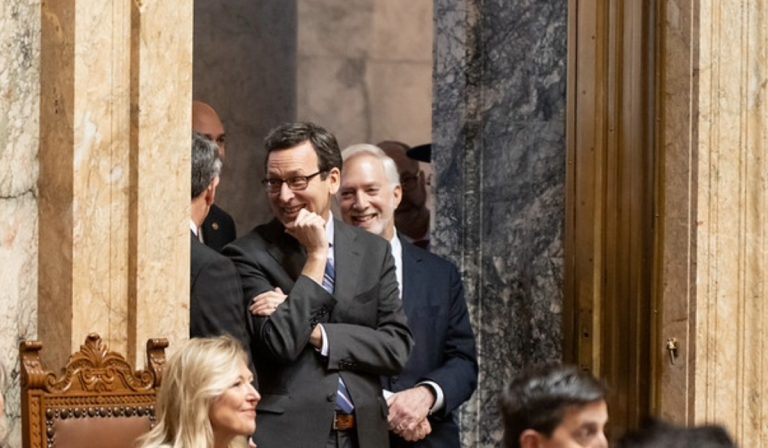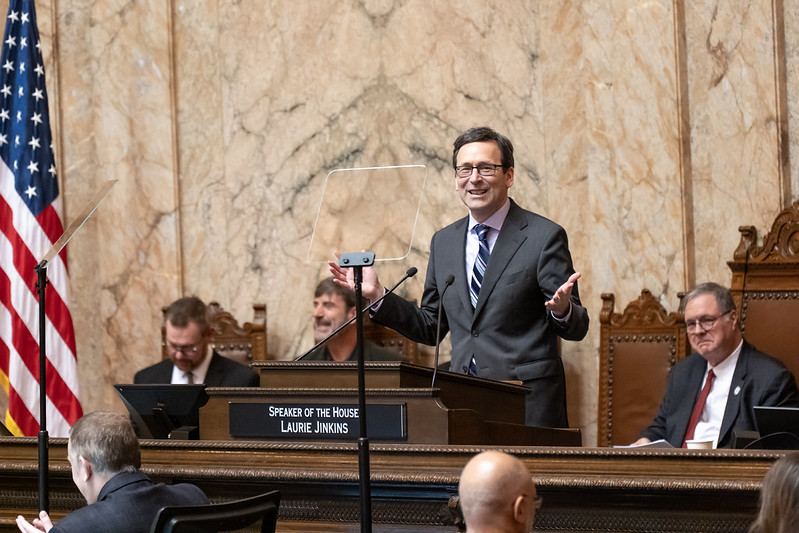
Governor Bob Ferguson delivers his first State of the State address to the Washington State Legislature. (WA governor's office)
OLYMPIA, Wash. — A Washington income tax proposal moved forward in Olympia this week, intensifying debate over state spending and fiscal priorities.
Lawmakers are considering SB 6346, often described as a “millionaires’ tax.” Supporters say it targets top earners and stabilizes revenue. Critics argue it could lead to a broader income tax.
“I’m confident that most people, including most millionaires, will support a Millionaires’ Tax where wealthy folks pay a bit more and Washington families and small businesses get tax relief,” Gov. Bob Ferguson said in January. “These dollars are going to help out thousands and thousands of Washingtonians.”
The Senate approved the measure, and now it is making its way through the House.
Feb. 24 hearing draws strong testimony
During a House committee hearing on Feb. 24, residents delivered pointed testimony about the proposal and the state’s fiscal direction.
“For five generations my family has been paying taxes here in Washington State,” Eric Lundberg told lawmakers. “It has been proven multiple times that this is the most unpopular bill in Washington state history.”
Lundberg also questioned whether public input would influence lawmakers.
“We are not here today to beg you,” he said. “We are here to test you to see if you truly believe that your power supersedes the will of the people.”
Republicans warn of broader tax impact
Washington Republicans criticized the bill following the Senate vote ten days ago.
In a statement, the Washington State GOP said Democrats passed the 9.9 percent income tax in the Senate while rejecting an amendment to ensure the tax only applies to millionaires.
Republicans argue the proposal could expand over time and point to strong opposition during hearings.
They also cited rising living costs and past tax increases as part of their broader fiscal concerns.
Spending priorities remain central issue
The debate reflects deeper disagreements over spending.
Supporters of new revenue measures argue targeted taxes on high earners would stabilize funding for public services and reduce reliance on consumption taxes, which disproportionately affect lower-income residents.
Republicans point to fee increases and program reductions as signs of strained priorities. They also raise concerns about government spending and financial oversight.
Supporters of the measure say new revenue would help fund education, healthcare, and other core services while easing reliance on sales taxes.
What happens next
House lawmakers will continue reviewing SB 6346 in committee in executive session on Friday, Feb. 27. The chamber could amend the proposal before any final vote.
If the House passes the bill, it would go to Ferguson’s desk.
Ferguson has floated pairing a high-earner tax with a statewide sales-tax holiday, a policy used in several states.
The decision will shape Washington’s fiscal outlook as lawmakers balance spending demands with calls for restraint.
Tax holiday proposal adds political dimension
Adding a layer of political complexity, Gov. Bob Ferguson has floated the idea of pairing a potential millionaires’ tax with a statewide sales-tax holiday.
“With a Millionaires’ Tax, let’s create a sales tax holiday in Washington state,” Ferguson said Thursday, noting that 18 states currently offer similar temporary tax breaks.
Missing from the debate: WDFW and hatcheries
The debate over taxes goes back and forth but ignores what most folks talk about outside of gas taxes and income taxes. Lawmakers make cuts and spend money on priorities that ignore several WDFW budget priorities as if they are now settled environmental policy.
Budget documents show lawmakers reduced or did not continue several programs tied directly to fisheries management, hatcheries, and public access.
The Washington Department of Fish and Wildlife says the Puget Sound salmon and steelhead monitoring program lost one-time funding. The agency says that decision eliminated the legal pathway required to open the Skagit River winter steelhead catch-and-release season and reduced scientific work on escapement modeling.
Lawmakers also reduced hatchery production evaluation funding that began in 2022. WDFW says the work was cut roughly in half, limiting the agency’s ability to analyze and adjust production levels.
The budget reduced funding tied to the Toutle and Skamania hatchery system. WDFW says the shortfall led to the permanent closure of Skamania Hatchery.
Another change removed funding from Aquatic Lands Enhancement Account volunteer grants. WDFW says the defunding eliminated about $900,000 used for habitat restoration, hatchery support, and community projects.
The agency also lost stewardship funding used to maintain roads, gates, and access points on WDFW lands. That reduction affects public entry to wildlife areas and water access sites.
Forest health funding saw a major drop as well. WDFW says the enacted budget reduced work from about $6 million to roughly $1.2 million.
Skagit steelhead shows how budget decisions affect seasons
WDFW directly links the lack of monitoring funding to the absence of a Skagit River steelhead season.
The agency says without money for modeling, federal consultation, and monitoring, it cannot legally propose a fishery under federal permits.
That means the season did not end through the public rule-setting process anglers typically see. It ended through the budget process that determines whether the required science and oversight can occur.
What lawmakers have not restored
WDFW’s current budget request lists programs the agency wants to restore or backfill. Proposed House and Senate budgets do not fund several of them.
One example is funding to increase officer presence. WDFW says the request would restore positions cut in the 2025-27 budget, but the proposal remains unfunded.
Another is funding tied to the Skamania Hatchery closure. WDFW says it needs resources to complete the closure and transition work, but lawmakers have not included the request and completely ignored it.
Why this matters in the tax debate
The comparison is straightforward.
Lawmakers are considering new revenue proposals, including SB 6346, while several fisheries and hatchery programs remain unfunded or reduced.
For anglers and outdoor communities, the budget decisions translate into fewer seasons, less monitoring, and reduced access.
That is why the debate over spending priorities resonates beyond Olympia. It shows up on the water.
About the Author