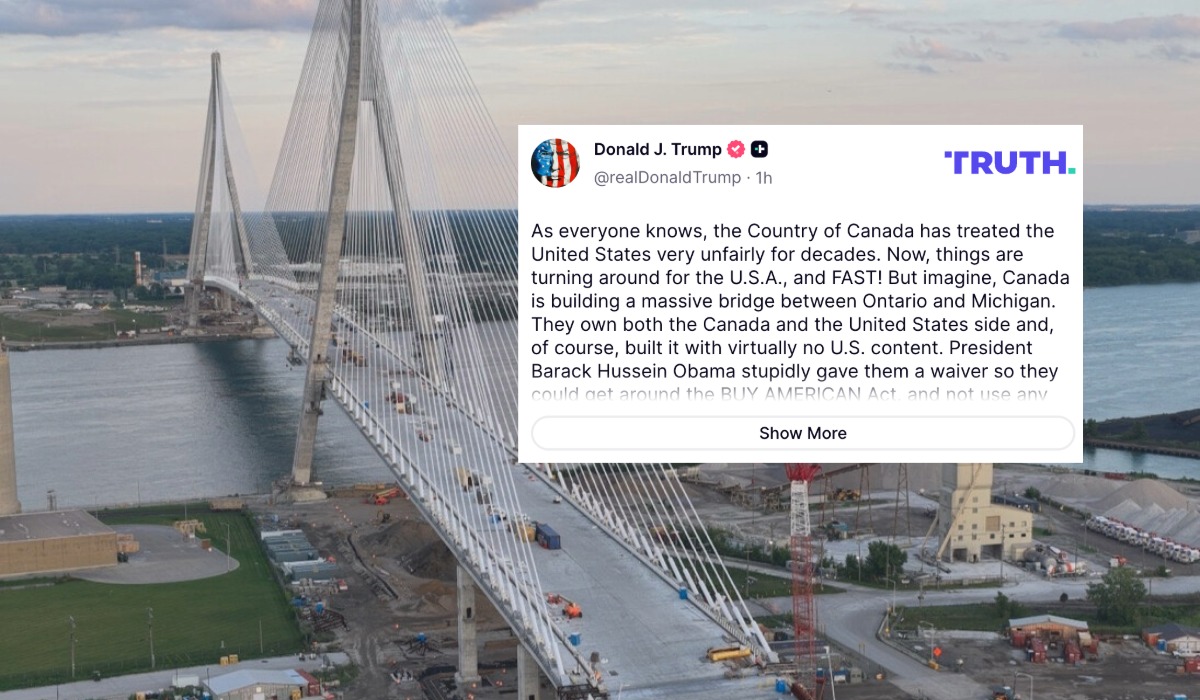
President Donald Trump says he will not allow a new bridge between Ontario and Michigan to open unless the United States is compensated.
BLAINE, Wash. — Border communities in northwest Washington and British Columbia are watching closely after President Donald Trump threatened Monday to block the opening of a major U.S.–Canada bridge unless the United States receives “compensation.”
In a Truth Social post Monday, Donald J. Trump said he would not allow the bridge between Ontario and Michigan to open until Canada compensates the U.S. and agrees to new ownership terms.
“As everyone knows, the Country of Canada has treated the United States very unfairly for decades,” Trump began. “Now, things are turning around for the U.S.A., and FAST! But imagine, Canada is building a massive bridge between Ontario and Michigan. They own both the Canada and the United States side and, of course, built it with virtually no U.S. content.”
Border stability remains critical in the Pacific Northwest
In Whatcom County and southwest British Columbia, the border shapes daily life. Residents cross frequently for work, shopping, and medical care. At the same time, commercial traffic moves agricultural products and manufactured goods in both directions.
Because of that reliance, local concern focuses on stability. If federal leaders delay or renegotiate major border infrastructure at the final stage, communities question how secure future access will be.
The bridge at the center of the dispute
Trump’s comments focus on the Gordie Howe International Bridge, a Canada-funded project linking Detroit and Windsor.
Canada financed construction and plans to recover costs through toll revenue once the bridge opens. Officials designed the crossing to ease congestion and provide redundancy to the privately owned Ambassador Bridge.
Trump said the project used little U.S. content and relied on a Buy American waiver approved during the Obama administration. He argued the United States receives no direct benefit and suggested the U.S. should own at least half of the bridge.
“President Barack Hussein Obama stupidly gave them a waiver so they could get around the BUY AMERICAN Act, and not use any American products, including our Steel,” Trump posted. “Now, the Canadian Government expects me, as President of the United States, to PERMIT them to just ‘take advantage of America!’ What does the United States of America get — Absolutely NOTHING! Ontario won’t even put U.S. spirits, beverages, and other alcoholic products, on their shelves, they are absolutely prohibited from doing so and now, on top of everything else, Prime Minister Carney wants to make a deal with China — which will eat Canada alive.”
Why western border communities are paying attention
Although the bridge sits far from the Pacific Northwest, the rhetoric resonates locally. Border residents remember how quickly access changed during pandemic closures and inspection slowdowns.
As a result, exporters, freight operators, and tourism businesses are watching closely. Any uncertainty in border policy can disrupt supply chains and local economies across the region.
Blaine and Birch Bay businesses saw roughly a 30% drop in revenue in 2025, but several area festivals and events have been permanently canceled due to a lack of Canadian participants.
Trade disputes resurface
Trump’s post also revisited long-standing trade disputes. He cited dairy tariffs, limits on U.S. alcohol sales in Ontario, and Canada’s economic ties with China.
Canada’s federal government, led by Mark Carney, has not yet publicly responded to Trump’s demands regarding compensation or ownership.
Trump said negotiations would begin immediately. However, he did not explain how the federal government would block the bridge’s opening or alter existing agreements.
About the Author