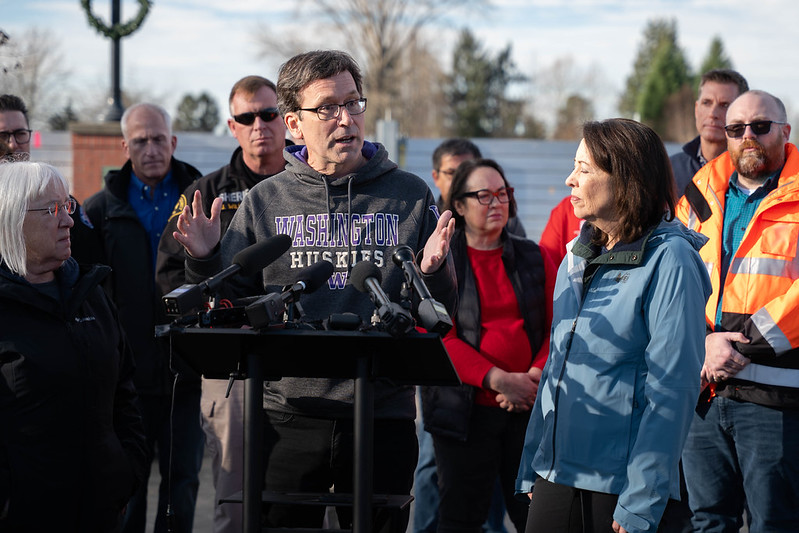
Gov. Ferguson, Senators Murray and Cantwell visit recovery areas affected by atmospheric river flooding.
BELLINGHAM, Wash. — Gov. Bob Ferguson formally asked President Donald Trump on Tuesday to approve a federal major disaster declaration for Washington, a move that could unlock an estimated $21.3 million in FEMA Individual Assistance for families still recovering from December’s historic flooding.
The request includes Whatcom and Skagit counties, where residents endured some of the region’s worst flooding in decades as atmospheric rivers pushed rivers beyond record levels, overwhelmed levees, and forced evacuations across low-lying communities.
If approved, the declaration would allow homeowners, renters, and others with limited means to apply directly to FEMA for financial help to repair homes, replace essential items, or secure temporary housing. It would also open the door to low-interest disaster loans through the U.S. Small Business Administration.
“The scale, duration, and severity of this disaster overwhelmed local and state response capabilities,” Ferguson said in a statement. “Thousands of families experienced devastating loss. Federal assistance is essential to help Washingtonians recover from these historic floods.”
Whatcom and Skagit among hardest-hit areas
PNW Daily has reported extensively on flood damage in both Whatcom and Skagit counties since early December, including road washouts, farmland losses, submerged homes, and prolonged power outages.
In Skagit County, the Skagit River reached its highest level in recorded history, overtopping banks and flooding agricultural areas that support much of the region’s food economy. In Whatcom County, flooding along the Nooksack River basin displaced families, shut down highways, and left some rural residents cut off for days.
State officials say about 30 rivers flooded statewide, with 33 exceeding flood stage and 18 reaching major flood levels. Nearly 4,000 homes were damaged, and about 440 were destroyed or sustained major damage.
More than 100,000 people were placed under evacuation orders during the 18-day storm sequence. Authorities conducted 383 emergency rescues, and one person died.
What FEMA Individual Assistance would cover
Ferguson’s request asks FEMA to approve the maximum level of Individual Assistance available. While that funding does not make survivors financially whole, it can provide critical short-term support.
FEMA Individual Assistance typically helps with:
- Temporary housing costs
- Basic home repairs
- Replacement of essential personal property
- Other serious disaster-related expenses
If the declaration is approved, residents must apply directly with FEMA to determine eligibility.
The request applies to residents in 10 counties, including Skagit and Whatcom, as well as 15 federally recognized Tribal nations.
State aid already distributed
Before seeking federal help, Washington released millions in emergency aid. The state has already provided:
- $3.5 million in emergency funding for food, shelter, and basic needs
- Nearly $1 million through the Disaster Cash Assistance Program
- Direct support to more than 2,600 households
More information about ongoing state and county assistance is available at FloodRecovery.wa.gov.
Infrastructure funding still pending
Ferguson’s request focuses on individual aid. A separate request for FEMA Public Assistance funding, which helps repair public infrastructure such as roads, levees, and public buildings, is expected in February after damage assessments are complete.
The state is also seeking Hazard Mitigation Grant Program funding to reduce the risk of future flooding, including projects like Mount Vernon’s flood wall, which officials say prevented even greater damage.
The deadline to apply for those federal programs is Feb. 18.
Regional impacts extended beyond homes
The storms disrupted nearly every major system in western Washington.
Officials report:
- 34 state-managed transportation routes damaged, including parts of two interstates and three U.S. highways
- Four-day suspension of Amtrak Cascades service between Seattle and Vancouver, B.C.
- About 450,000 customers lost power
- 15 emergency shelters opened at peak
- A skilled nursing facility evacuated 78 patients
- Seven Tribal nations and 13 counties issued disaster declarations
The Washington State Emergency Operations Center activated at its highest level, and Ferguson deployed about 400 National Guard members to assist with rescues, evacuations, sandbagging, and debris removal.
What happens next
Later this week, Washington’s congressional delegation and leaders of all four state legislative caucuses are expected to send bipartisan letters supporting Ferguson’s request.
If the federal government approves the major disaster declaration, FEMA will open applications for residents in eligible counties.
PNW Daily will continue tracking FEMA eligibility, application timelines, and county-level recovery resources for Whatcom and Skagit residents.
How FEMA aid works
If the federal government approves Washington’s request, FEMA assistance will not be divided by county.
Instead, FEMA evaluates each household individually based on documented need. Awards depend on factors such as the level of damage to a primary residence, whether the home is livable, insurance coverage, income, and essential personal property losses.
There is a per-household cap on how much FEMA can provide each year. That limit typically falls in the low-to-mid $40,000 range for housing and other needs combined. Most recipients receive far less than the maximum.
FEMA assistance is meant to stabilize people after disasters, not fully rebuild homes or replace everything that was lost. It can help with temporary housing, limited home repairs, essential items such as beds or appliances, and accessibility-related needs.
Insurance is considered first. FEMA usually covers only what insurance does not.
The $21.3 million estimate cited by the governor reflects a projected statewide total, not a fixed pool divided among counties.
Stay tuned for more PNW Daily coverage in the Pacific Northwest.
About the Author